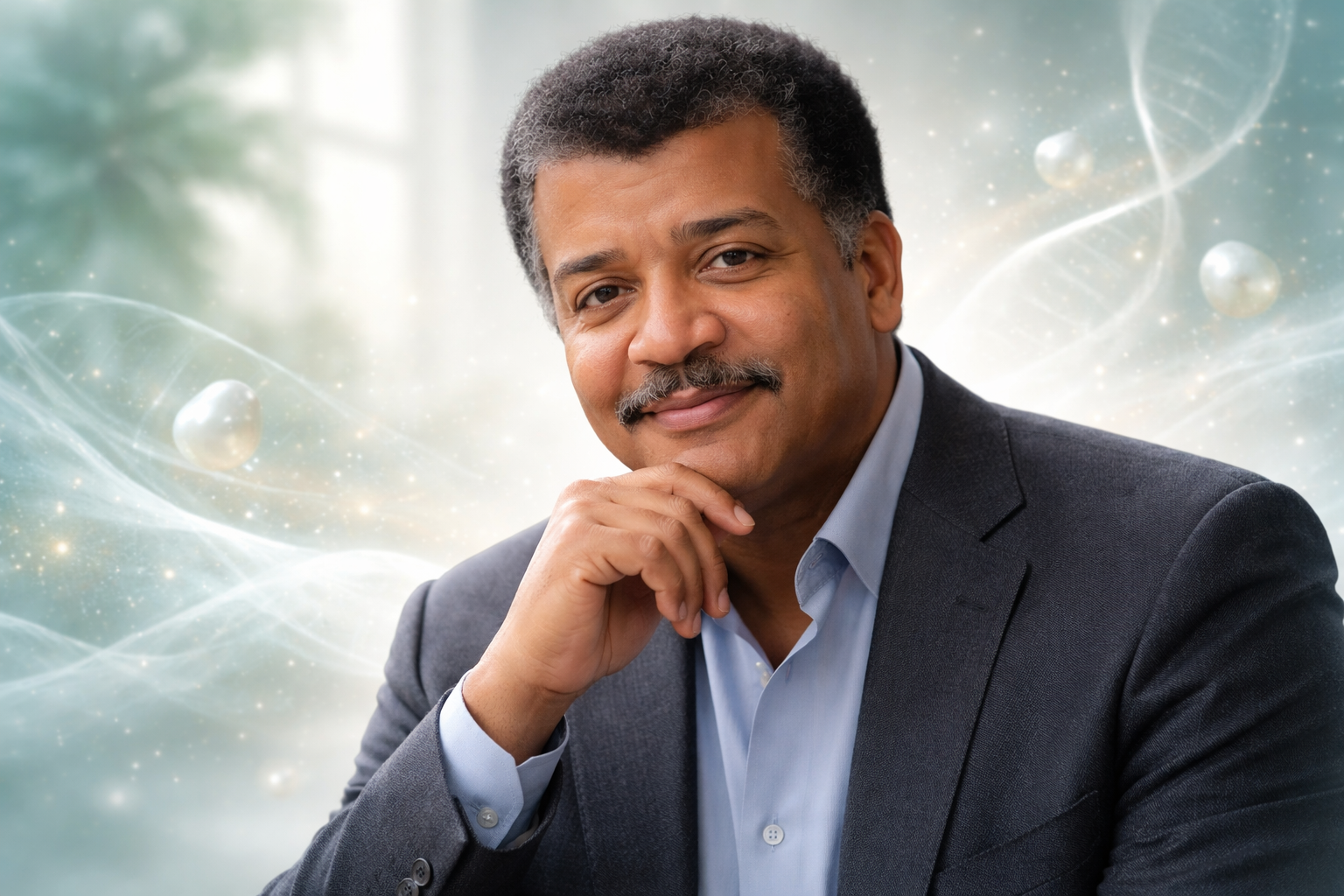
Neil deGrasse Tyson is an American astrophysicist widely recognized for his major role in science communication. Director of the Hayden Planetarium in New York, he has become a central figure in bridging science and society. His work indirectly informs longevity by placing scientific knowledge, rational thinking, and innovation at the core of human progress.
A media figure as much as a scientist, Neil deGrasse Tyson embodies a form of accessible intellectual authority. His calm yet assertive voice spans conferences, television programs, and publications, consistently emphasizing that understanding the world relies on measurable facts. In a context where longevity is emerging as both a technological and societal challenge, he does not propose direct biomedical solutions but instead defends a foundational principle: critical thinking. As he states: “The good thing about science is that it’s true whether or not you believe in it,” an idea that underpins any serious approach to health and human progress. His positioning extends beyond astrophysics, shaping how societies engage with their future.
The journey
Neil deGrasse Tyson’s path follows a seemingly classical scientific trajectory, yet it is marked early on by a rare ability to communicate. Born in New York, he developed an early fascination with the stars, notably after a formative visit to the Hayden Planetarium. This experience quickly evolved into a vocation. He pursued studies in physics at Harvard and later in astrophysics at Columbia, building a strong academic foundation.
What truly distinguishes Tyson, however, is his gradual shift toward public engagement. In the 1990s, at a time when research remained largely confined to academic circles, he chose to address a broader audience. His appointment as director of the Hayden Planetarium marked a turning point, transforming the institution into a modern educational platform. His visibility expanded significantly with programs such as Cosmos: A Spacetime Odyssey, where he continued the legacy of Carl Sagan.
This moment of media recognition established Tyson as a global reference. He no longer simply explained the universe; he actively shaped how the public relates to science. This evolution has indirect but meaningful implications for fields where scientific rigor is essential, including longevity research.
His vision of longevity
Neil deGrasse Tyson is not a researcher in aging biology, yet his worldview profoundly influences how longevity can be understood. For him, human progress depends first on the ability to distinguish belief from knowledge. In this sense, longevity is not a mythical pursuit but a scientific problem requiring method and evidence.
He frequently emphasizes the importance of scientific literacy in enabling informed decisions. In public discussions, he notes that “Science is a way of thinking much more than it is a body of knowledge.” This perspective reframes longevity not as an isolated technological promise, but as the outcome of an intellectual ecosystem grounded in rigor.
Tyson also warns against pseudoscientific drift, which is common in the health and wellness space. According to him, any meaningful advancement must be tested, reproducible, and validated. This requirement is critical in a field where claims of life extension can easily lead to unsubstantiated narratives.
His vision of the future remains nonetheless optimistic. He believes that scientific progress, when properly understood and applied, can significantly transform the human condition. Longevity becomes part of a broader dynamic: the continuous refinement of knowledge and its responsible application. What matters is not only lifespan, but the quality of the decisions that shape it.
Influence and impact
Neil deGrasse Tyson’s influence extends far beyond astrophysics. By democratizing access to science, he operates on a fundamental lever: public scientific literacy. This literacy directly shapes how innovations in health and longevity are perceived, accepted, or challenged.
His impact is particularly visible in his efforts to counter misinformation. In an environment saturated with information, he promotes an evidence-based approach, contributing to more rational discussions around emerging technologies. His stance has also sparked criticism, with some pointing to a tone that can be perceived as overly direct or to instances of simplification. Nevertheless, his role remains central in making scientific thinking more accessible.
In practical terms, his influence fosters a better public understanding of scientific issues. This creates a more favorable environment for the acceptance of innovation, particularly in health and life extension. While he does not develop these technologies himself, he helps create the societal conditions that make their emergence possible.
Science, rigor, and the future of longevity
Neil deGrasse Tyson occupies a unique position within the longevity ecosystem: that of an intellectual architect rather than a biomedical innovator. By advocating for a rigorous approach to science, he contributes to establishing the conditions necessary for sustainable progress. In a world increasingly filled with technological promises, his insistence on scientific method serves as an essential safeguard. Longevity, in this context, is not solely a biological question, but one of understanding reality itself. And it is precisely on this terrain that the future will unfold.