Definition
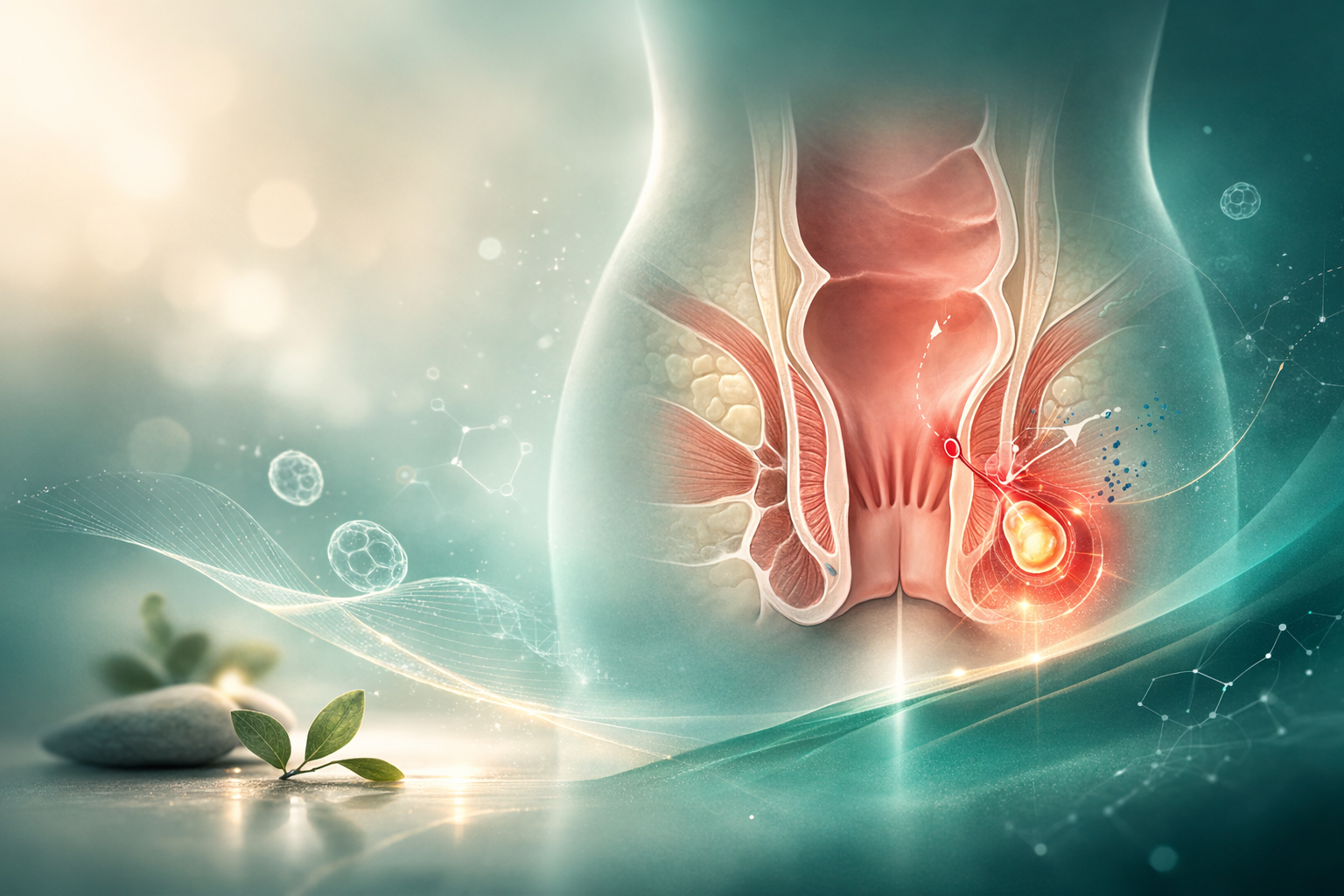
A perianal abscess is a localized collection of pus in the soft tissues surrounding the anus. It most commonly results from an acute infection of an obstructed anal gland. These glands, located in the wall of the anal canal, can become blocked, allowing bacterial proliferation and the formation of a purulent cavity.
Clinically, the abscess presents with intense, throbbing anal pain that worsens when sitting or during defecation. A red, warm and tender swelling may be visible near the anal opening. Fever, malaise or chills may occur in more extensive infections.
It is a common surgical emergency in proctology. Without drainage, the infection can spread to deeper perineal spaces or progress to a chronic anal fistula.
Origin and context of use
Perianal abscess most often arises from a cryptoglandular infection. Anal crypts, small invaginations located at the anorectal junction, communicate with glands that secrete mucus. Obstruction of these ducts promotes bacterial stagnation.
The bacteria involved originate from the intestinal flora, including anaerobes and enterobacteria. Certain factors increase risk: poorly controlled diabetes, immunosuppression, inflammatory bowel disease such as Crohn’s disease, or a history of previous abscess.
The term is used in digestive surgery and proctology to distinguish superficial abscesses from deeper forms (ischiorectal, intersphincteric or supralevator), which require specific management.
How does it work?
The process begins with obstruction of an anal gland. Accumulated secretions create a favorable environment for bacterial growth. The local immune response triggers acute inflammation: influx of neutrophils, release of inflammatory mediators, vasodilation and increased vascular permeability.
Tissue destruction caused by infection leads to the formation of a cavity filled with pus, composed of bacteria, inflammatory cells and necrotic debris. Intratissue pressure rises, explaining the severe, throbbing pain experienced by the patient.
Depending on the path of spread, the infection may remain superficial or extend into deeper anatomical spaces around the anal sphincter. If the abscess ruptures spontaneously or is drained, an abnormal tract may persist between the anal canal and the skin: this is an anal fistula, a common complication.
Treatment is based on surgical drainage. Incision allows evacuation of pus, reduction of pressure and control of infection. Antibiotics alone are insufficient without drainage.
In which cases is it used?
The diagnosis of perianal abscess is made in the presence of acute anal pain associated with inflammatory swelling. Clinical examination is usually sufficient.
Imaging with endoanal ultrasound or pelvic MRI may be indicated in cases of diagnostic uncertainty, suspected deep extension or recurrence.
Management is performed as an urgent procedure, often in an outpatient surgical setting. In immunocompromised patients or those with severe systemic signs, hospitalization and intravenous antibiotics may be required.
Benefits and objectives
Treatment aims to rapidly control infection and prevent local or systemic complications. Surgical drainage makes it possible to:
✓ evacuate the purulent collection
✓ relieve pressure-related pain
✓ limit spread to deeper spaces
✓ reduce the risk of sepsis
✓ identify a possible associated fistulous tract
Early management reduces morbidity and shortens symptom duration. Another objective is preservation of sphincter function, which is essential for anal continence.
Risks, limitations or controversies
The main complication is the development of a secondary anal fistula, observed in a significant proportion of cases. Risk varies according to location and extent of infection.
Recurrence may occur, especially in the presence of predisposing factors such as Crohn’s disease. Transient continence disturbances can follow more extensive procedures.
Antibiotic therapy alone is not recommended as first-line treatment except in specific situations. The question of simultaneous treatment of an associated fistula may be debated and depends on intraoperative assessment.
Research and innovations
Current research focuses on improving early diagnosis of deep forms through high-resolution pelvic MRI, aiming to better map associated fistulous tracts.
Minimally invasive surgical techniques are being evaluated to treat both abscess and fistula while preserving the anal sphincter. Approaches using biological glues or occlusive devices are under study in selected contexts.
Management of patients with Crohn’s disease involves protocols combining surgical drainage with biologic therapies targeting intestinal inflammation.
Short FAQ
Can a perianal abscess heal on its own?
Spontaneous healing is rare. A spontaneous rupture may occur, but it does not eliminate the risk of fistula formation or recurrence. Surgical drainage remains the reference treatment to control infection.
What is the difference between an abscess and an anal fistula?
An abscess is an acute infection with a collection of pus. A fistula is a persistent abnormal tract between the anal canal and the skin, often secondary to an inadequately resolved abscess.
Is treatment always surgical?
Yes. Drainage is essential. Antibiotics alone cannot evacuate the purulent collection and are not sufficient to treat the infection.
Is the procedure painful?
Pain related to the abscess is usually more intense than postoperative discomfort. Local or general anesthesia is used depending on the situation.
Can a perianal abscess be prevented?
There is no specific prevention. Control of risk factors such as diabetes and appropriate management of inflammatory bowel disease may reduce risk.
Is it contagious?
No. A perianal abscess results from an internal infection related to the patient’s own digestive flora. It is not transmitted by contact.
How long does healing take?
Healing generally takes a few weeks. Regular local wound care is required to ensure proper recovery.
Is there a risk of sepsis?
Yes, particularly if treatment is delayed or in vulnerable patients. High fever and general malaise require urgent medical evaluation.
Can the abscess recur?
Recurrence is possible, especially if an underlying fistula or chronic inflammatory disease is present.
Can continence be affected?
In simple cases, the risk is low. Sphincter impairment is mainly associated with complex forms or repeated surgical procedures.
Key points
Perianal abscess is an acute infection of the tissues surrounding the anus, most often caused by obstruction of an anal gland. It leads to severe pain, swelling and sometimes fever. Management relies on prompt surgical drainage. Without treatment, complications such as anal fistula may occur. Careful clinical assessment and consideration of risk factors determine prognosis and help prevent recurrence.
Related Articles
Related Longevity Concepts
Scientific context
Field: Clinical medicine, biology, and preventive health
Biological process: Human physiology, pathology, and health-related mechanisms
Related systems: Metabolic, immune, cardiovascular, nervous, and cellular systems
Relevance to longevity: Understanding medical terminology and biological processes helps clarify how diseases, symptoms, biomarkers, and treatments influence long-term health, prevention, and healthy aging.