Definition
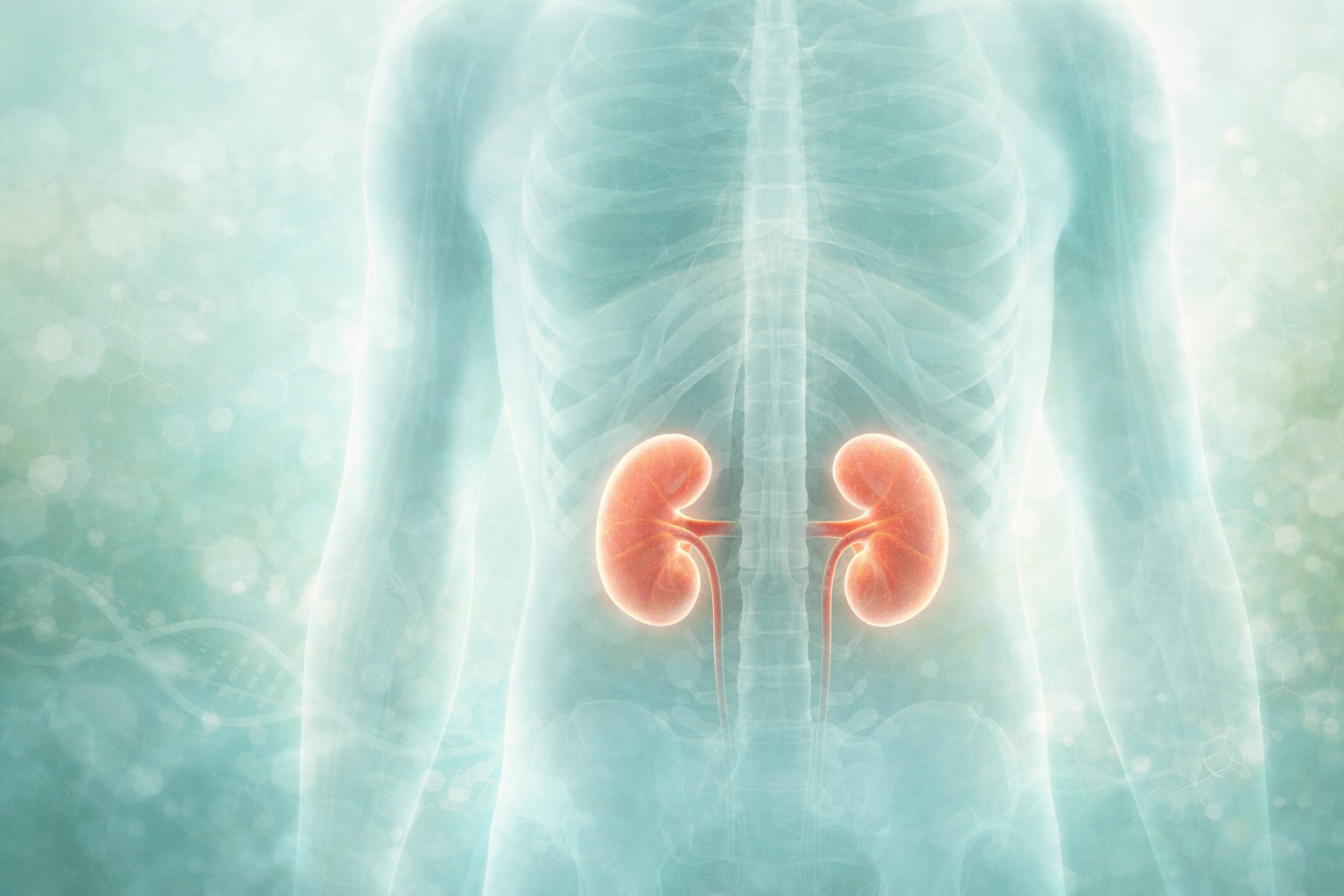
The kidneys are two bean-shaped organs that form part of the urinary system. Their main function is to filter blood, remove metabolic waste, regulate fluid balance and maintain stable levels of electrolytes such as sodium and potassium.
Each kidney processes blood continuously through millions of microscopic filtration units called nephrons. These structures remove waste products and excess substances, which are then excreted as urine through the ureters toward the bladder.
In adults, each kidney typically measures about 10–12 centimeters in length and weighs roughly 120–170 grams. The organs are positioned symmetrically on each side of the spine but are slightly asymmetrical in height.
The kidneys are located deep inside the upper posterior part of the abdominal cavity. Because they lie behind the peritoneal lining, they are classified as retroperitoneal organs. Their position protects them with surrounding muscles, fat and parts of the rib cage.
Exact location in the body
The kidneys sit on both sides of the spine in the upper back portion of the abdomen, just below the rib cage.
Key anatomical landmarks include:
-
Positioned roughly between the T12 and L3 vertebrae of the spine
-
Located behind the abdominal organs (retroperitoneal space)
-
Protected partially by the 11th and 12th ribs
The right kidney sits slightly lower than the left kidney because the liver occupies space above it.
Approximate positions:
-
Left kidney: slightly higher, beneath the diaphragm and spleen
-
Right kidney: slightly lower due to the presence of the liver
Internal orientation
Each kidney has two main sides:
-
Medial side: faces the spine and contains the renal hilum, where blood vessels, nerves and the ureter enter or exit
-
Lateral side: faces outward toward the abdominal wall
The upper poles of the kidneys lie close to the adrenal glands, small endocrine glands that sit on top of each kidney.
Surface anatomy (how it relates to the body surface)
From the outside of the body, the kidneys are generally located:
-
In the middle to lower back, slightly above the waist
-
On both sides of the spine
-
Beneath the lower ribs
Kidney pain is therefore often felt in the flank region, the area between the ribs and the hips on the back.
Protective structures around the kidneys
Several layers protect the kidneys and stabilize their position:
-
Renal capsule: thin fibrous layer directly covering the kidney
-
Perirenal fat: fatty tissue that cushions the organ
-
Renal fascia: connective tissue anchoring the kidney in place
-
Muscles of the posterior abdominal wall: including the psoas major and quadratus lumborum
These structures help protect the kidneys from mechanical shock and maintain their stable anatomical position.
Summary
The kidneys are located in the upper posterior abdomen on both sides of the spine, just below the rib cage. They lie in the retroperitoneal space between the T12 and L3 vertebrae, with the right kidney slightly lower than the left because of the liver. Their deep position in the back explains why kidney pain is typically felt in the flank or lower back region.
Related Longevity Concepts
Scientific context
Field: Clinical medicine, biology, and preventive health
Biological process: Human physiology, pathology, and health-related mechanisms
Related systems: Metabolic, immune, cardiovascular, nervous, and cellular systems
Relevance to longevity: Understanding medical terminology and biological processes helps clarify how diseases, symptoms, biomarkers, and treatments influence long-term health, prevention, and healthy aging.