Definition
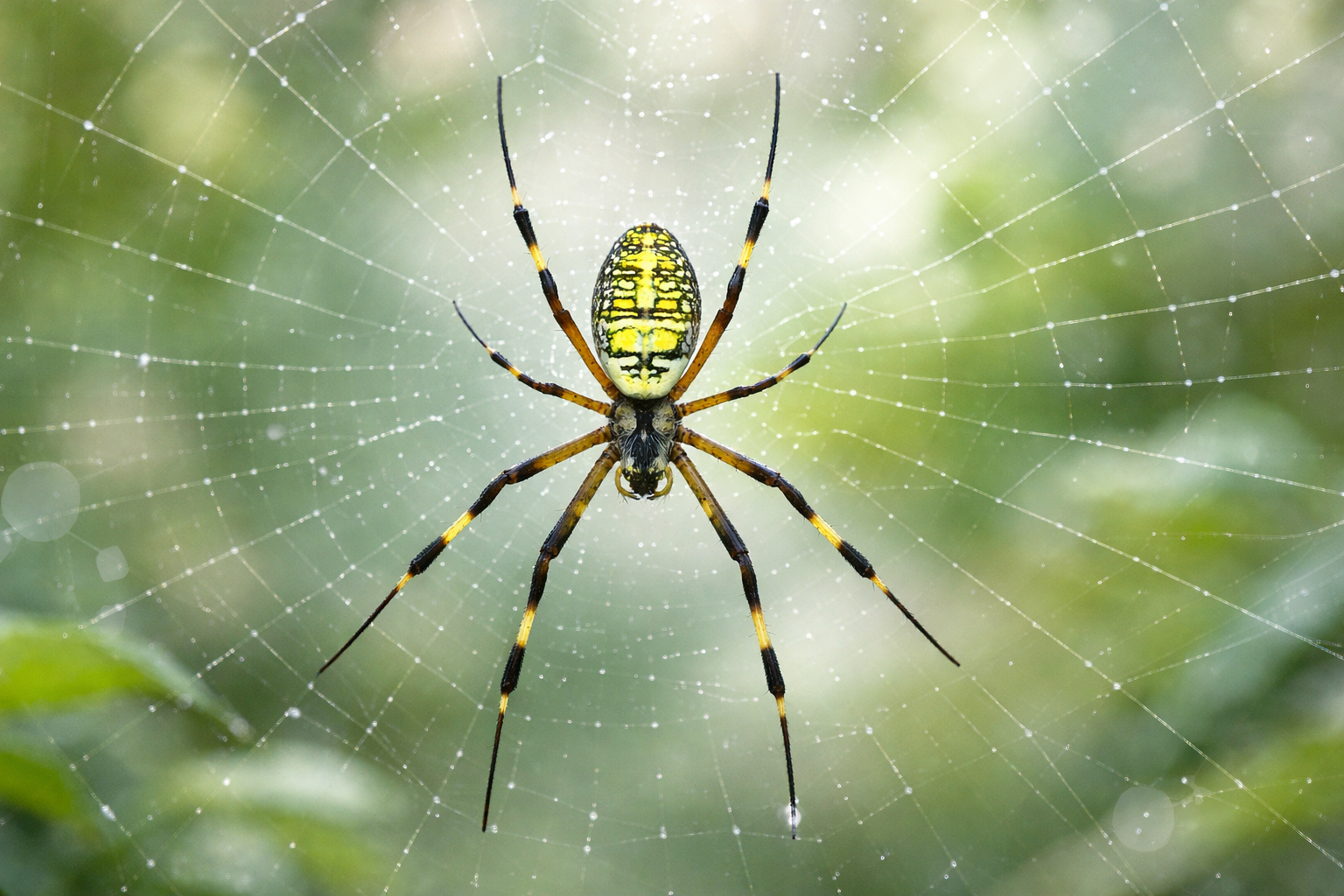
The Joro spider is a large orb-weaving spider belonging to the species Trichonephila clavata. Native to East Asia, it is known for its bright coloration, large size and distinctive golden orb webs. Adult females typically measure between 17 and 25 millimeters in body length, with leg spans that can exceed 10 centimeters, making them among the most visually striking web-building spiders.
This species belongs to a group of spiders specialized in producing large, strong orb webs designed to capture flying insects. The web can appear slightly golden due to pigments present in the silk and the way it reflects light.
The Joro spider is primarily an outdoor species. It builds large circular webs between trees, shrubs, buildings or utility structures. Its ecological role is mainly predatory, feeding on a wide range of insects including flies, mosquitoes, beetles and moths.
Despite its impressive appearance, the species is not aggressive toward humans. Bites are uncommon and generally occur only when the spider is directly handled or pressed against the skin.
Origin and context of use
The Joro spider originates from East Asia, particularly Japan, Korea, China and Taiwan. In these regions it has long been part of local ecosystems and seasonal wildlife. In Japan, the species is often associated with autumn, when adult females become more visible as they grow larger and build extensive webs.
Outside its native range, the spider has gained attention because of its spread in North America. Established populations were first documented in the U.S. state of Georgia around 2013. The introduction likely occurred accidentally through international shipping, plant trade or cargo transport.
Young spiders have the ability to disperse through a process called ballooning. In this behavior, spiderlings release extremely fine silk strands that catch air currents, allowing them to travel through the atmosphere and settle in new locations.
This dispersal capacity has led scientists to study the species closely in order to understand its potential ecological impact and expansion patterns.
How does it work?
The biology of the Joro spider is centered on web construction and predation. The spider builds a large orb web composed of radial threads connected by spiral adhesive strands. This structure acts as an efficient trap for flying insects.
When an insect strikes the web, the sticky silk restricts movement. Vibrations travel along the radial threads and allow the spider to detect the location and size of the captured prey.
The spider approaches the trapped insect and injects venom through its fangs. The venom contains neurotoxic compounds that interfere with the nervous system of small arthropods. Once the prey is immobilized, the spider wraps it in silk.
Digestion begins externally. The spider releases digestive enzymes that liquefy internal tissues before ingesting the resulting nutrient-rich fluid.
The species also shows strong sexual dimorphism. Females are much larger and responsible for building and maintaining the web. Males are significantly smaller and usually remain near the female’s web in order to mate.
After reproduction, females produce egg sacs that can contain hundreds of eggs. These eggs typically overwinter and hatch during the following spring.
In which cases is it encountered?
Joro spiders are typically encountered in outdoor environments that provide structures suitable for web construction. Forest edges, suburban gardens, parks and agricultural landscapes are common habitats.
They frequently anchor their webs between tree branches, fences, utility poles or building corners. The webs can span several meters and may be positioned anywhere from near ground level to several meters above it.
Human encounters usually occur when people walk through vegetation or along paths where webs have been built across open spaces. Because the webs are large and sometimes located at head height, they can occasionally appear in residential areas.
Observations are most common during late summer and early autumn, when adult females reach full size and webs become easier to see.
Benefits and objectives
Despite concerns about its expansion, the Joro spider contributes to several ecological functions.
✓ Helps regulate populations of flying insects such as flies and mosquitoes
✓ Participates in natural pest control within ecosystems
✓ Provides prey for birds and other insect-eating animals
✓ Contributes to ecological diversity in regions where it becomes established
✓ Serves as a model species for research on spider silk and web mechanics
The spider’s silk is of particular scientific interest. Orb-weaving spiders produce fibers that combine elasticity and high tensile strength, properties studied in biomaterials research.
Within ecosystems, the Joro spider mainly functions as a generalist predator integrated into local food webs.
Risks, limits or controversies
The venom of the Joro spider is not considered medically significant for humans. Documented bites are rare and usually produce mild local symptoms such as redness, slight swelling or brief pain comparable to a bee sting.
Most concerns relate instead to the species’ introduction into regions outside its native range. Researchers study whether its spread could influence native spider populations or alter insect community structures.
Current observations suggest that the species can coexist with several native spiders, though long-term ecological effects are still being examined.
Public concern is often driven more by the spider’s large size and conspicuous webs than by any real medical risk.
Research and innovations
Scientific research on the Joro spider focuses on ecology, dispersal mechanisms and the physical properties of its silk. Researchers study how the species adapts to new environments and climates in regions where it has recently appeared.
Ballooning behavior is a major topic of investigation. Scientists analyze how spiderlings use silk strands and atmospheric conditions to travel through the air and colonize new habitats.
Another research area concerns the structure and strength of spider silk. Orb-weaving spiders produce fibers with exceptional mechanical properties that combine flexibility with strength. These characteristics make spider silk a model material for studies in biomaterials engineering.
Genetic research also helps track population origins and better understand the expansion of introduced populations.
Short FAQ
What is a Joro spider?
The Joro spider is a large orb-weaving spider species native to East Asia. It is known for its colorful body and its large circular web with a golden appearance. The spider mainly feeds on flying insects captured in its web.
Are Joro spiders dangerous to humans?
They are generally not dangerous. Bites are uncommon and usually happen only if the spider is directly handled. When they occur, symptoms are typically mild and limited to localized pain or redness.
How large can Joro spiders grow?
Adult females usually reach 17 to 25 millimeters in body length, with leg spans that may exceed 10 centimeters. Males are much smaller and often remain unnoticed near the female’s web.
Where are Joro spiders found?
They are native to Japan, Korea, China and Taiwan. Established populations have also been observed in parts of the United States, particularly in the southeastern region.
What do Joro spiders eat?
Their diet mainly consists of flying insects such as flies, mosquitoes, moths and beetles. Any small arthropod that becomes trapped in the sticky web may become prey.
Why do their webs appear golden?
The silk contains pigments that can reflect light, producing a golden coloration under certain lighting conditions. This visual effect may also help the web blend into surrounding vegetation.
Do Joro spiders live inside houses?
They rarely live indoors. The species prefers outdoor environments where it can anchor large orb webs between vegetation or structures.
How do Joro spiders spread to new areas?
Young spiders disperse through ballooning. They release fine silk strands that allow them to be carried by wind currents to new locations.
When are Joro spiders most visible?
They are most noticeable in late summer and early autumn when adult females reach their largest size and build large, visible webs.
Should Joro spiders be removed if found?
Removal is usually unnecessary because they pose little risk and help control insect populations. If a web is located in a high-traffic area, it can simply be relocated or removed.
Scientific context
Field: Clinical medicine, biology, and preventive health
Biological process: Human physiology, pathology, and health-related mechanisms
Related systems: Metabolic, immune, cardiovascular, nervous, and cellular systems
Relevance to longevity: Understanding medical terminology and biological processes helps clarify how diseases, symptoms, biomarkers, and treatments influence long-term health, prevention, and healthy aging.
Key Takeaways
The Joro spider is a large orb-weaving species originally from East Asia that has attracted attention due to its spread into new regions. It builds large golden-tinted webs used to capture flying insects. Despite its impressive size and appearance, it poses minimal risk to humans. Its ecological role is mainly that of an insect predator. Ongoing research focuses on its dispersal abilities, adaptation to new environments and the exceptional mechanical properties of its silk.
Related Articles
Related Longevity Concepts