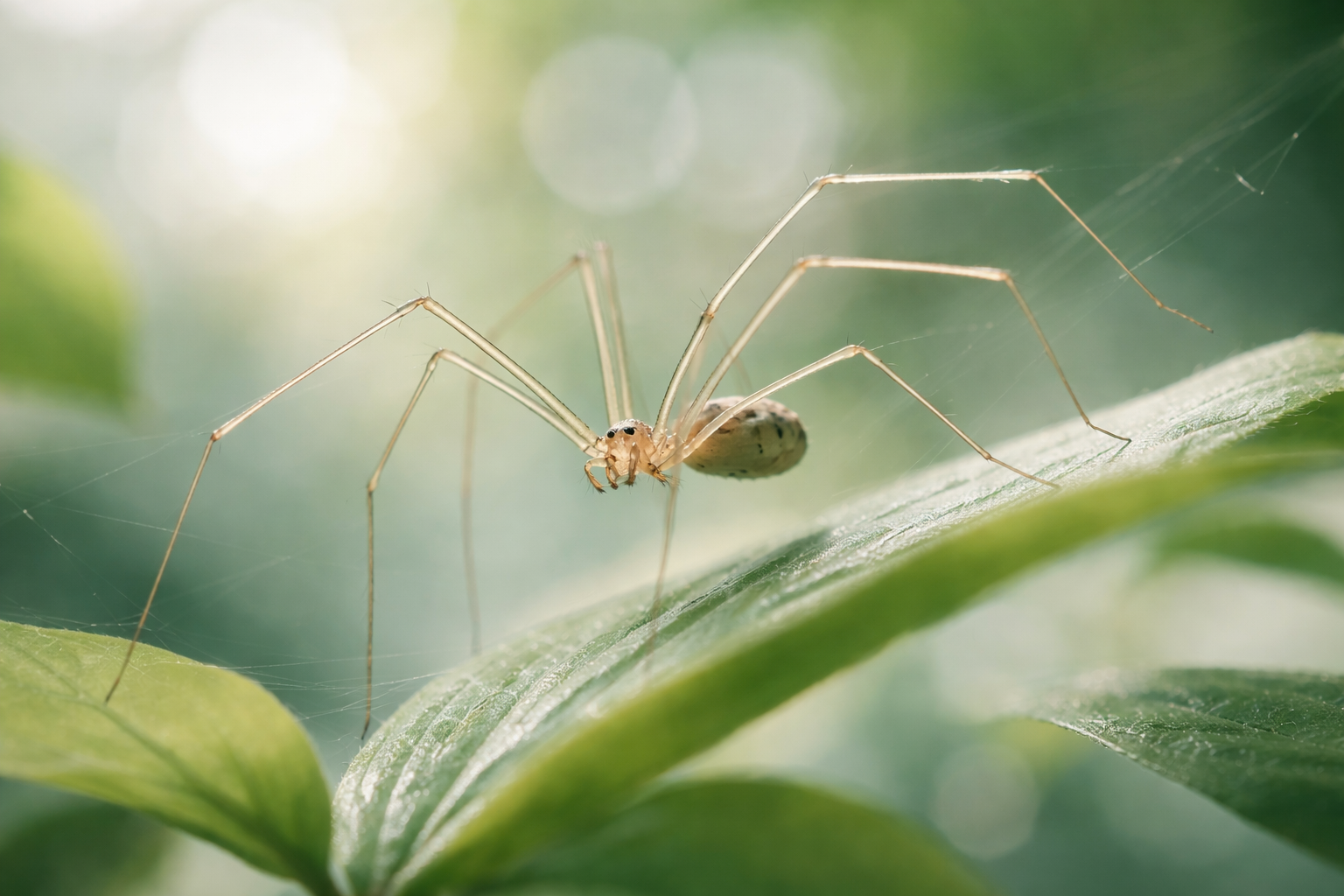
Definition
Cellar spiders are primarily members of the Pholcidae family, which is commonly referred to as « pholques » in French. They can be identified by their long, delicate legs, slender bodies, and asymmetrical webs that are placed in quiet, undisturbed spaces like cellars, ceilings, or wall corners. Their legs can span several centimeters, but their body size is still modest.
These spiders are found in many human settings and have a subtle but significant function in controlling other arthropods. They are not a serious threat to humans, despite what some people believe. They rarely bite, and their poison is weak.
Their presence is frequently interpreted as a sign of a stable, unclean, or small-prey-rich environment. They coexist without direct contact with human residents and readily adapt to indoor conditions.
Origin and context of use
With the exception of the polar regions, all continents are home to the ancient spider family Pholcidae. They have been adapted to enclosed spaces for numerous centuries, and they gradually colonized human homes because they offered reliable refuge and a steady supply of food.
When it comes to « pests, » cellar spiders are not strictly speaking regarded as problematic organisms. In a logic of natural biological regulation, they are occasionally even accepted or even encouraged. This impression is explained by their capacity to catch other insects, even unwanted kinds.
These indoor spiders are referred to as « cellar spiders » in Anglo-Saxon literature. Usage is still more erratic in French, alternating between « cave spiders » and scientific terms.
How does this work?
Cellar spiders lack a precise geometric form and instead create loose, asymmetrical webs. Unlike orb-weavers, their webs are not made to passively ensnare animals. Instead, they endorse an active capture tactic.
The spider uses sensory receptors on its legs to sense vibrations when an insect touches the web. It then starts to vibrate quickly, a distinctive movement that blurs its silhouette and makes it challenging for predators to target. The prey may become confused as a result of this vibration.
She then goes up to the prey, wraps it in silk to render it immobile, and then injects her poison. Digestive enzymes included in this venom facilitate suction ingestion by liquefying interior tissues.
Additionally, cellar spiders are well-known for their capacity to ensnare larger species of spiders. They trap these rivals by taking advantage of their agility and disorganized web. They are more persistent in nutrient-poor habitats because of their slow metabolism, which enables them to go for extended periods of time without eating.
When is it used?
Cellar spiders are incorporated into some ecological pest management strategies, however they are not « used » in the sense of a controlled tool. In homes that are conducive to their growth, they spontaneously emerge.
They are most prevalent in ancient or poorly ventilated structures such as : basements, cellars, garages, and attics, as well as the corners of unclean ceilings.
They aid in reducing the number of flying or crawling insects in certain situations. In domestic micro-ecosystems, their impact is quantifiable but indirect.
They can support a passive control strategy, but they can not take the place of a planned control strategy against serious infestations.
Benefits and goals
In an indoor setting, cellar spiders have a number of advantages:
✔ natural reduction of insect populations
✔ predation of potentially more troublesome spiders
✔ absence of significant health risk
✔ low interaction with humans
✔ maintenance of local biological balance
They take part in a kind of nonverbal control. Although their activity lowers the density of small prey, their influence is still restricted to their local surroundings.
Their tolerance implicitly aims to limit chemical exposure in inhabited areas by providing biological control without the need for insecticides.
Risks, limitations, or controversies
There is no significant health risk associated with cellar spiders. Most of the time, its venom poses no threat to people; bites are an exception.
Their appearance is the primary drawback. Their erratic webs might build up and appear unclean or neglected. This can be considered inappropriate in some domestic or professional settings.
They are still only moderately effective against pests. They make it impossible to manage serious infestations, especially those involving cockroaches or bedbugs.
They are said to contain extremely strong venom, although their teeth are not strong enough to pierce human skin. This assertion is untrue.
Research and new developments
The behavior, biomechanics, and ecological relationships of Pholcidae are the primary areas of study. Because of their capacity to ensnare other spiders, trophic networks are of special importance.
Biomechanics analyzes their vibrational behavior to comprehend passive defense tactics. Robotics and dynamic camouflage systems research is motivated by this mechanism.
Their silk has intriguing strength and flexibility characteristics, although being less researched than that of orb-weavers.
Without taking into account their breeding or regulated introduction, biological control research concentrates on their indirect role in controlling insects.
Short FAQ
Are people at risk from cellar spiders?
No. They rarely bite, and their poison is weak. In a typical domestic setting, they avoid contact and do not present a serious medical concern.
In their web, why do they vibrate?
Self-defense is the reason behind this conduct. The vibration increases their chances of survival by obscuring their visual position and upsetting predators or prey.
Can they get rid of other spiders?
Indeed. Their agility and wrapping style allow them to catch and eat other spiders, occasionally larger ones.
Do they need to be removed from the house?
It is dependent upon the tolerance threshold. Although their presence may be seen unattractive, they are helpful in limiting insects.
Where can you find them most frequently?
Basements, ceilings, wall corners, garages, and attics are places that are quiet and poorly lit.
Do they procreate fast?
Their rate of reproduction is moderate. Until the eggs hatch, the females carry them in their chelicerae.
Does their website work well?
Unlike other spiders, it is not sticky. It primarily serves as an attack support and a vibratory trap.
Can they go a long time without eating?
Indeed. They can go weeks without eating because of their poor metabolism.
Are other pests drawn to them?
No. They don’t actively seek out prey; instead, they take use of what is already there.
Do they react negatively to pesticides?
Indeed. Conventional chemical treatments remove them, which may upset the local balance.
Key information
Members of the Pholcidae family, cellar spiders are frequently found in homes. Their lengthy legs and asymmetrical webs set them apart. Their primary function is to catch insects and other spiders, so supporting a covert natural regulation. They are not dangerous to people. On the other hand, their presence could be viewed as ugly. They support a local ecological balance without human intervention, although their efficacy is still restricted in the face of severe infestations.
Related Longevity Concepts
Scientific context
Field: Clinical medicine, biology, and preventive health
Biological process: Human physiology, pathology, and health-related mechanisms
Related systems: Metabolic, immune, cardiovascular, nervous, and cellular systems
Relevance to longevity: Understanding medical terminology and biological processes helps clarify how diseases, symptoms, biomarkers, and treatments influence long-term health, prevention, and healthy aging.