Definition
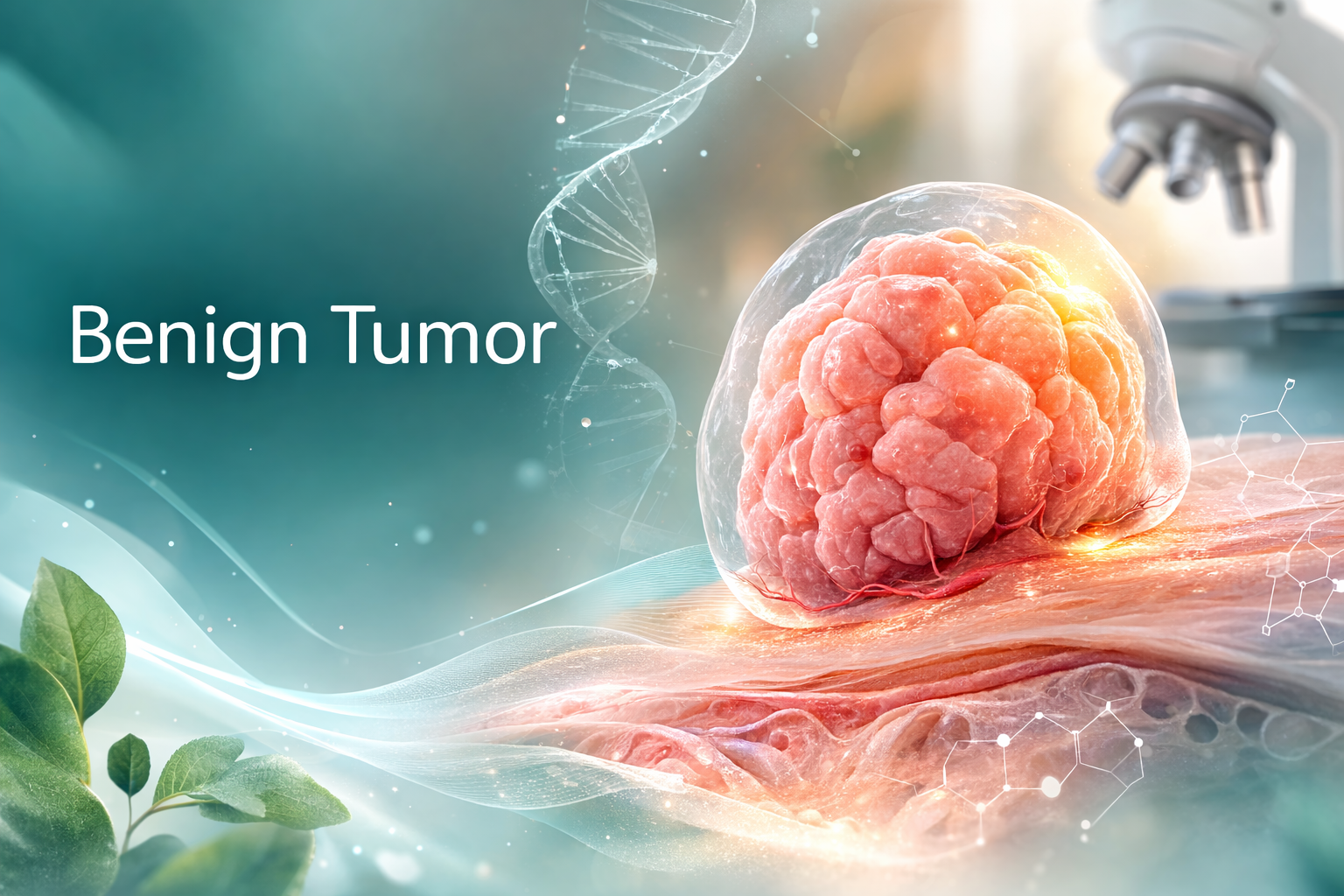
A benign tumor is a localized, non-cancerous growth of cells that proliferate abnormally but do not invade surrounding tissues or metastasize. Unlike malignant tumors, benign tumors maintain a relatively normal cellular structure and often grow slowly. They can develop in nearly any tissue, including skin, glands, muscles, and organs. Their growth can sometimes compress nearby structures, causing functional disturbances or discomfort, but they generally do not pose a direct threat to life. Benign tumors are usually encapsulated, which allows for clear boundaries visible during imaging or surgical removal. Common examples include lipomas (fat tissue), adenomas (glandular tissue), and fibromas (fibrous tissue). Diagnosis relies on clinical examination, imaging techniques, and sometimes histological analysis following biopsy. The term underscores the non-aggressive nature of the tumor, distinguishing it from malignant neoplasms that invade tissues, disrupt organ function, and have metastatic potential.
Origin and Context of Use
The term originates from Latin, with “benignus” meaning kind or favorable, reflecting the non-cancerous behavior of these growths. Clinically, identifying a tumor as benign is essential to avoid unnecessary aggressive treatments and to plan appropriate management. Benign tumors are frequently encountered in routine medical practice, detected during physical exams, imaging studies, or incidentally during investigations for unrelated conditions. Their management depends on location, size, symptoms, and potential complications. In many cases, benign tumors require monitoring rather than immediate intervention. Their study is significant for understanding abnormal cell proliferation and the transition mechanisms that could lead to malignancy in rare circumstances.
How Does It Work?
Benign tumors arise from abnormal cell growth due to genetic or epigenetic alterations that increase proliferation or decrease programmed cell death. Unlike malignant cells, they maintain normal cell-to-cell adhesion and architecture, preventing invasion into adjacent tissues. Growth is typically slow and often limited by encapsulation or natural tissue boundaries. They can cause local effects by compressing surrounding structures, leading to pain, obstruction, or organ dysfunction depending on the site. For example, a pituitary adenoma may disrupt hormone regulation, while a meningioma may exert pressure on brain tissue. Diagnosis involves imaging modalities such as ultrasound, MRI, or CT scans to determine size, structure, and vascularity. Histopathological examination confirms cellular characteristics, ruling out malignancy. The stability of benign tumors generally allows for elective surgical removal or conservative monitoring, minimizing patient risk.
When Is It Used?
Benign tumor assessment is important in the context of:
-
evaluation of palpable lumps in the skin, breast, or soft tissue;
-
imaging studies identifying incidental masses in organs like the liver, kidneys, or brain;
-
symptoms arising from compression or hormonal effects;
-
preoperative planning for elective surgery;
-
long-term monitoring to detect changes that could suggest malignant transformation.
Benefits and Objectives
Identifying and managing benign tumors provides:
-
✓ prevention of unnecessary aggressive treatment;
-
✓ relief of local symptoms caused by compression;
-
✓ correction of functional disturbances (e.g., hormonal imbalances);
-
✓ monitoring for rare malignant transformation;
-
✓ planning safe surgical excision when necessary.
Risks, Limitations or Controversies
Although benign tumors are non-cancerous, they can pose risks by compressing vital structures, especially in the brain, airways, or spinal cord. Rarely, benign tumors can transform into malignant forms. Some tumors, while histologically benign, can recur after removal if excision is incomplete. Imaging may sometimes be insufficient to distinguish between benign and early-stage malignant lesions, requiring biopsy for definitive diagnosis. Patient anxiety can arise from the presence of any tumor, influencing decisions toward surgery even when observation would suffice.
Research and Innovations
Current research explores molecular pathways regulating cell proliferation and apoptosis to better predict which benign tumors might progress to malignancy. Advanced imaging techniques, such as functional MRI or PET scans, improve characterization of vascularization and metabolic activity. Minimally invasive treatments, including laser ablation, radiofrequency, and targeted pharmacological therapy, are under study to reduce the need for surgery. Genetic profiling is increasingly used to distinguish tumors with low versus higher risk of aggressive behavior, enhancing personalized monitoring strategies.
Short FAQ
What is a benign tumor? A growth of cells that does not invade or metastasize, generally slow-growing and non-lethal.
How does it differ from a malignant tumor? Benign tumors do not spread, while malignant tumors invade tissues and metastasize.
Are benign tumors dangerous? Usually not, but they can compress organs or cause functional issues.
How are benign tumors diagnosed? Through physical examination, imaging, and sometimes biopsy.
Can benign tumors become cancerous? Rarely, some types may transform over time.
Do benign tumors require treatment? Only if symptomatic, growing, or at risk of complications.
What are common examples? Lipomas, fibromas, and adenomas.
Can benign tumors recur after removal? Yes, especially if excision is incomplete.
Are they hereditary? Some benign tumors have genetic predispositions.
Can imaging alone confirm benignity? Often suggestive, but histological confirmation may be necessary.
Scientific context
Field: Clinical medicine, biology, and preventive health
Biological process: Human physiology, pathology, and health-related mechanisms
Related systems: Metabolic, immune, cardiovascular, nervous, and cellular systems
Relevance to longevity: Understanding medical terminology and biological processes helps clarify how diseases, symptoms, biomarkers, and treatments influence long-term health, prevention, and healthy aging.
Key Takeaways
Benign tumors are non-cancerous cell growths that rarely threaten life but may cause local effects. Diagnosis relies on imaging and sometimes biopsy. Management focuses on symptom relief, monitoring, and safe surgical removal if necessary.
Related Longevity Concepts