Definition
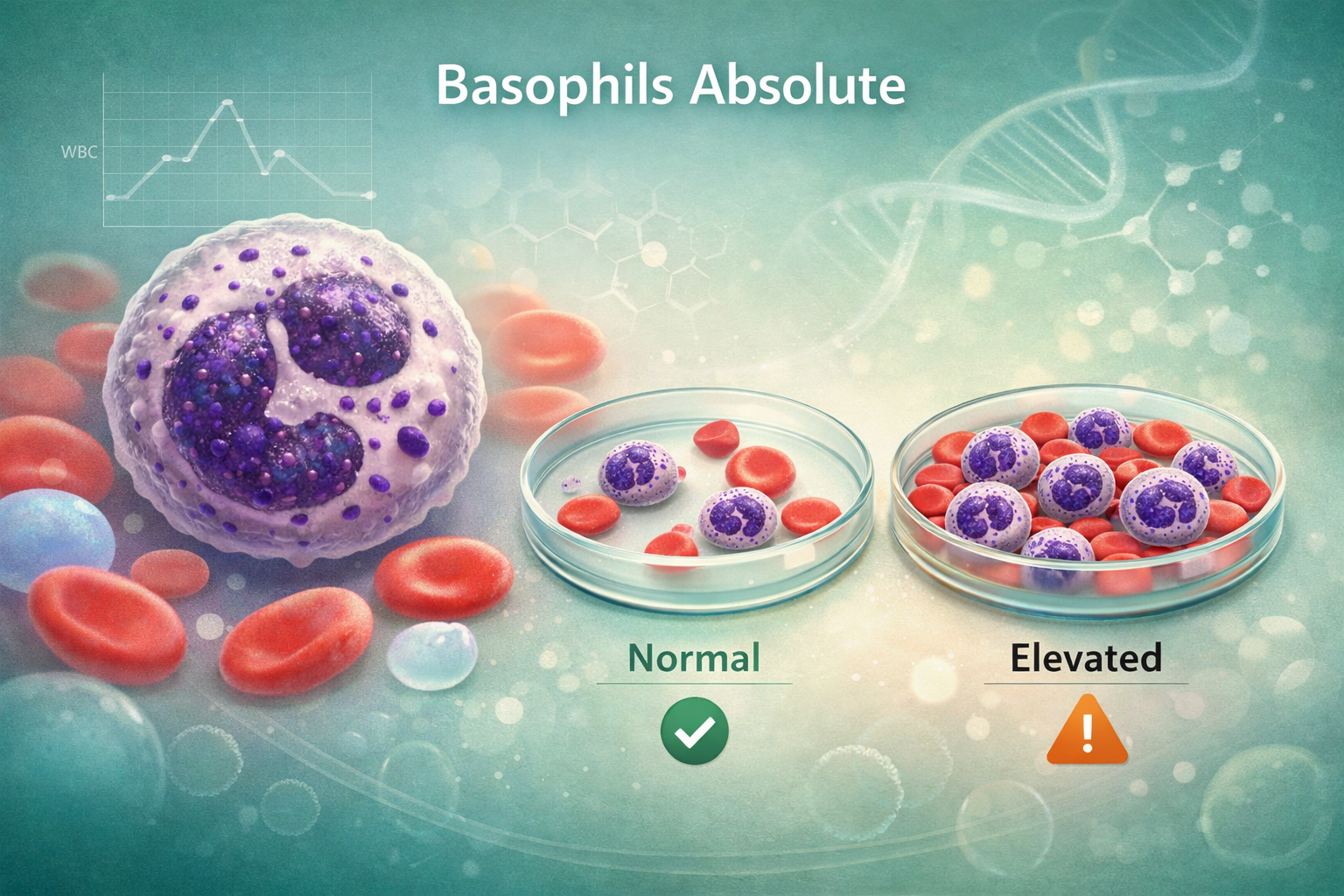
Basophils absolute refers to the exact number of basophils circulating in the bloodstream, measured in cells per microliter (µL) of blood. Basophils are a type of white blood cell, or leukocyte, representing less than 1% of circulating leukocytes under normal conditions. They play a role in immune defense, particularly in allergic reactions, inflammation, and responses to parasites.
The absolute basophil count differs from the basophil percentage, which indicates their proportion relative to total white blood cells. Measuring basophils in absolute numbers provides a more precise evaluation, especially when total white blood cell counts are abnormal.
Normal absolute basophil values typically range from 0 to 300 cells/µL in adults. Elevations or decreases can indicate an ongoing immune response, blood disorders, or chronic inflammation. The test is part of a complete blood count with differential, often ordered during routine health checks or to investigate unexplained symptoms.
Origin and context of use
Basophils were first described in the late 19th century as a distinct class of granulocytes identifiable by their staining properties with basic dyes. Early research distinguished basophils from other white blood cells due to their cytoplasmic granules containing histamine, heparin, and other mediators.
Absolute basophil counts became standard with the development of automated hematology analyzers, allowing accurate measurement rather than relying solely on microscopic differential counts. This improvement enabled clinicians to monitor subtle changes in immune cell populations.
Today, basophil absolute counts are used in routine hematology panels, allergy testing, and the evaluation of chronic inflammatory or myeloproliferative disorders. They provide information beyond percentages, helping detect mild abnormalities that may be clinically relevant.
How does it work?
Basophils are produced in the bone marrow from hematopoietic stem cells under the regulation of cytokines such as interleukin-3 (IL-3). Once matured, they circulate in the blood and can migrate to tissues during inflammatory or allergic reactions.
The granules in basophils contain histamine, heparin, and enzymes. During immune activation, these cells release their granule contents, triggering local inflammation, vasodilation, and recruitment of other immune cells. This process is essential for defense against parasites and in hypersensitivity responses.
The absolute basophil count is measured from a blood sample using automated hematology analyzers that can detect and quantify these cells accurately. The measurement provides a precise count, allowing clinicians to identify elevations (basophilia) or decreases (basopenia).
Basophilia can occur in conditions such as chronic myeloid leukemia, allergic disorders, hypothyroidism, or infections. Basopenia is less common but may be observed in acute infections, stress responses, or hyperthyroidism.
In which situations is it used?
Basophil absolute counts are measured to:
-
Detect allergic responses and hypersensitivity reactions
-
Monitor chronic inflammation or autoimmune diseases
-
Assist in diagnosing hematologic disorders such as leukemia or myeloproliferative syndromes
-
Evaluate immune system activity in infections or inflammatory conditions
This test is often performed alongside a complete blood count with differential to provide a comprehensive view of leukocyte populations and identify abnormalities that may not be evident from total white blood cell counts alone.
Benefits and objectives
The absolute basophil count offers several clinical advantages:
✓ Provides precise quantification of basophils independent of total white blood cell counts
✓ Helps identify immune activation, allergy, or inflammation
✓ Supports the diagnosis and monitoring of hematologic disorders
✓ Detects subtle changes in basophil levels that percentages might miss
✓ Complements other blood tests for a comprehensive assessment of immune status
✓ Guides treatment decisions in allergic, inflammatory, or hematologic conditions
The test is rapid, minimally invasive, and widely available in clinical laboratories. It provides actionable information for both acute and chronic medical conditions.
Risks, limitations or controversies
Basophil absolute counts are generally safe and non-invasive since they rely on standard blood sampling. However, interpretation has limitations:
-
Low basophil counts (basopenia) are often non-specific and may not indicate a serious condition.
-
Elevated counts (basophilia) require correlation with clinical context and other laboratory findings to distinguish between allergic, inflammatory, or hematologic causes.
-
Laboratory variability may occur due to differences in automated analyzer technology.
-
Basophils constitute a very small fraction of white blood cells, making microscopic verification sometimes challenging.
Consequently, basophil counts are most meaningful when integrated with other blood parameters and clinical information.
Research and innovations
Recent research has focused on the role of basophils in immune regulation, allergy, and inflammation. Studies suggest basophils contribute to adaptive immunity by interacting with T cells and releasing cytokines that influence other immune cells.
Advances in flow cytometry and single-cell analysis allow more detailed characterization of basophil function, granule content, and activation states. These innovations may improve the understanding of allergic diseases, autoimmune disorders, and myeloproliferative syndromes.
Additionally, combining basophil absolute counts with biomarkers such as IgE or histamine levels enhances diagnostic accuracy in allergy testing and monitoring therapeutic responses.
Short FAQ
What is a normal basophil absolute count?
Normal values range from 0 to 300 cells/µL in adults. Counts outside this range may suggest immune activation, allergic responses, or hematologic disorders.
Why do doctors measure basophils absolute?
The test helps detect allergies, inflammation, chronic disease, or blood disorders and complements a complete blood count with differential.
What causes basophilia?
Basophilia (high basophils) may result from chronic myeloid leukemia, allergic reactions, hypothyroidism, or chronic inflammation.
What causes basopenia?
Basopenia (low basophils) can appear in acute infections, stress responses, hyperthyroidism, or after corticosteroid treatment.
Is basophil absolute better than percentage?
Yes. Absolute counts provide a precise number independent of total white blood cell variations, which can make percentages misleading.
How is basophil absolute measured?
It is measured from a blood sample using automated hematology analyzers that quantify individual white blood cell populations.
Does a high basophil count always indicate disease?
No. Mild elevations can occur in normal allergic responses or transient inflammation. Persistent or marked increases require further investigation.
Can basophil counts change daily?
Yes. Levels can fluctuate slightly due to stress, infection, or circadian variations but significant changes are usually clinically relevant.
Are there symptoms of abnormal basophil levels?
Basophil count abnormalities themselves usually do not cause symptoms. Clinical signs are related to underlying conditions such as allergy, infection, or blood disorders.
Can treatment normalize basophil absolute counts?
Yes. Treating the underlying cause, such as controlling allergies, inflammation, or managing hematologic disorders, can return basophil levels to normal.
Key points to remember
Basophils absolute represents the precise number of basophils in the blood, providing valuable insight into immune system activity. It is useful for detecting allergic responses, inflammation, and hematologic disorders. Normal counts range from 0 to 300 cells/µL, and deviations may indicate various conditions. Interpretation requires correlation with clinical context and other laboratory tests. Measuring basophils in absolute numbers offers greater accuracy than percentages and supports diagnosis, monitoring, and treatment planning.
Related Longevity Concepts
Scientific context
Field: Clinical medicine, biology, and preventive health
Biological process: Human physiology, pathology, and health-related mechanisms
Related systems: Metabolic, immune, cardiovascular, nervous, and cellular systems
Relevance to longevity: Understanding medical terminology and biological processes helps clarify how diseases, symptoms, biomarkers, and treatments influence long-term health, prevention, and healthy aging.