Definition
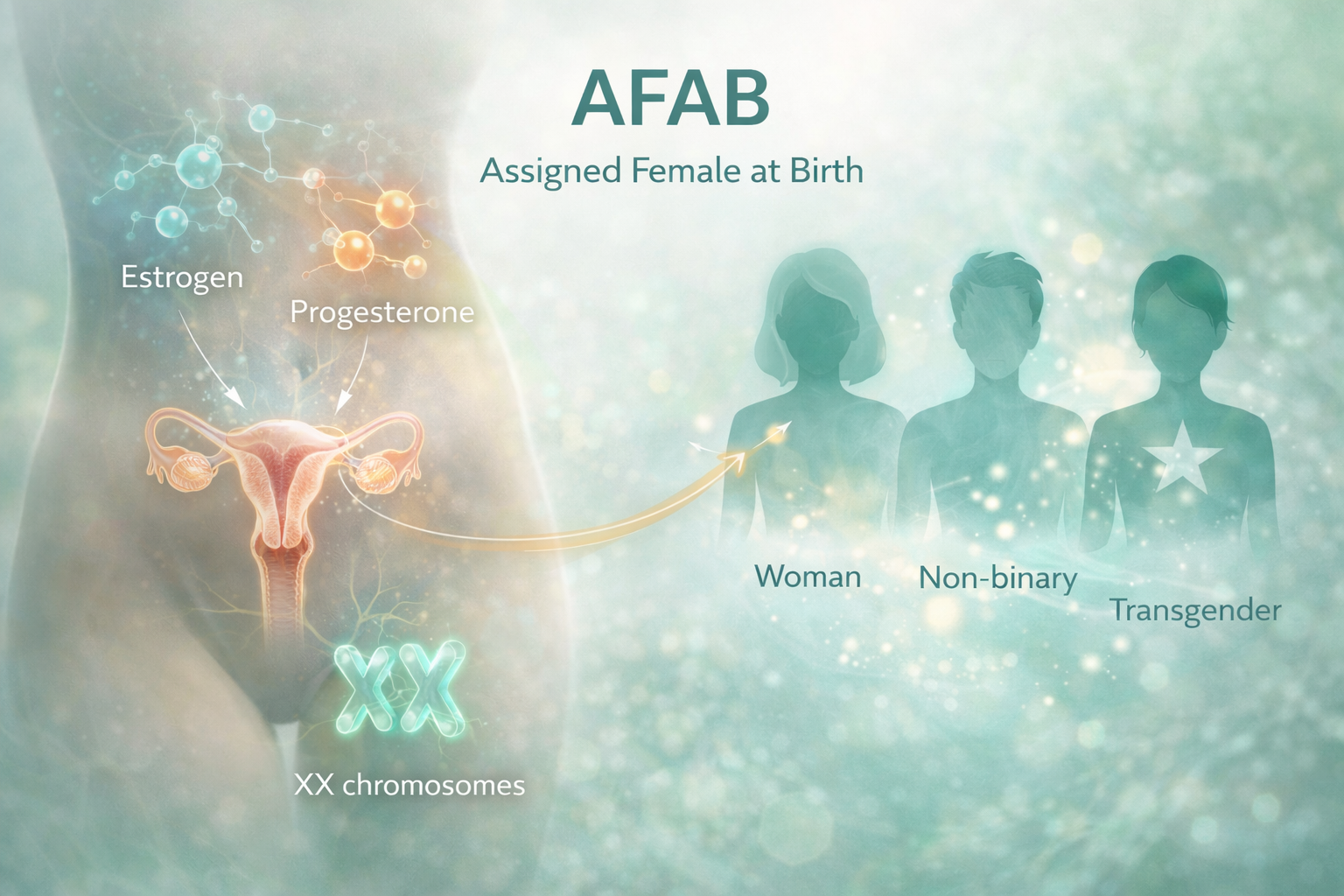
AFAB stands for “Assigned Female At Birth,” referring to a person whose sex was recorded as female at birth, usually based on the appearance of external genitalia. This term does not assume the person’s current gender identity, which can be cisgender, transgender, non-binary, or otherwise. AFAB is primarily used in medical, social, and academic contexts to distinguish the sex assigned at birth from the lived gender identity. It allows addressing specific health concerns and population statistics without imposing a gender identity. It is often paired with its counterpart “AMAB” (“Assigned Male At Birth”) and is part of efforts to ensure inclusive and precise communication in medical and social contexts.
Origin and Context of Use
The term AFAB emerged in the 1990s in gender studies and LGBTQ+ health research. It arose from the need for neutral, precise, and respectful language to separate birth-assigned sex from gender identity. In medical records, epidemiological studies, and public health programs, AFAB allows tracking biological indicators (such as menstruation or pregnancy) while acknowledging gender diversity. Its use promotes inclusive communication in research, policy, and clinical settings, avoiding assumptions about an individual’s identity or sexual orientation.
How It Works
AFAB relies on distinguishing between assigned sex and gender identity. At birth, medical staff determine sex by observing external genitalia. This assignment influences certain medical and administrative pathways, including hospital records and identification documents. However, a person assigned female at birth may identify as a trans man, non-binary, or remain a cisgender woman. Recognizing this distinction impacts clinical practice, including hormone therapy, gender-affirming surgery, contraception, pregnancy, and gynecological follow-up. In research, AFAB is used to segment populations and analyze biological indicators without assuming gender identity. It balances the right to self-identification with scientific accuracy.
When It Is Used
AFAB is employed in:
-
Medicine and reproductive health to tailor care to initial biological characteristics.
-
Epidemiological research to analyze data differentiated by assigned sex.
-
Health education and prevention programs targeting specific populations (e.g., contraception, menstrual health).
-
Inclusive communication in professional and social settings to respect gender identity.
-
Administrative and legal records when distinguishing assigned sex from lived gender is necessary for statistics or care.
Benefits and Objectives
Using AFAB allows:
-
✔ Accuracy in medical care and prescriptions.
-
✔ Respect for gender identities while accounting for biological characteristics.
-
✔ Improved epidemiological data collection and statistics.
-
✔ Inclusive communication in educational, social, and professional contexts.
-
✔ Targeted prevention and health education adapted to specific needs.
Risks, Limitations, or Controversies
AFAB can be misunderstood or perceived as reductive if the context is unclear. Some consider the acronym emphasizes the body at birth and may feel medicalizing. In administrative records, confusing AFAB with gender identity can cause errors in care or access to services. The term is also mainly used in English-speaking and LGBTQ+ contexts, limiting its global recognition.
Research and Innovations
Recent studies examine how AFAB and AMAB usage improves inclusion and care accuracy. Research focuses on:
-
Adapting medical protocols for transgender and non-binary individuals.
-
Collecting data differentiated by assigned sex and gender identity.
-
Integrating AFAB/AMAB concepts into electronic health records.
-
Training healthcare professionals to reduce biases related to gender and assigned sex.
These developments aim to balance medical precision and respect for identities while facilitating research on diverse populations’ health.
Short FAQ
What does AFAB mean?
AFAB means “Assigned Female At Birth,” the sex recorded as female at birth.
Does AFAB mean female?
No, AFAB describes assigned sex at birth, not gender identity.
What is the difference with AMAB?
AMAB refers to people assigned male at birth, the counterpart to AFAB.
Is AFAB a medical term?
Yes, it is used in health, epidemiology, and gender research.
Does AFAB imply specific care?
It guides some biological care, but gender identity affects the medical path.
Is AFAB inclusive?
Yes, it separates assigned sex from gender identity without assumption.
AFAB and transgender identity?
An AFAB person can identify as trans, non-binary, or cisgender.
Can AFAB status be changed?
Assigned sex at birth is historical; gender identity can evolve.
Is AFAB legally recognized?
It is not a formal legal term but used in medical and social documentation.
Does AFAB replace gender?
No, it complements gender information and biological needs.
Scientific context
Field: Clinical medicine, biology, and preventive health
Biological process: Human physiology, pathology, and health-related mechanisms
Related systems: Metabolic, immune, cardiovascular, nervous, and cellular systems
Relevance to longevity: Understanding medical terminology and biological processes helps clarify how diseases, symptoms, biomarkers, and treatments influence long-term health, prevention, and healthy aging.
Key Takeaways
AFAB identifies the sex assigned at birth as female, regardless of current gender identity. It supports medical accuracy, research, and inclusive communication. Its use requires a clear distinction from gender identity and awareness of social and medical contexts.
Related Longevity Concepts