Definition
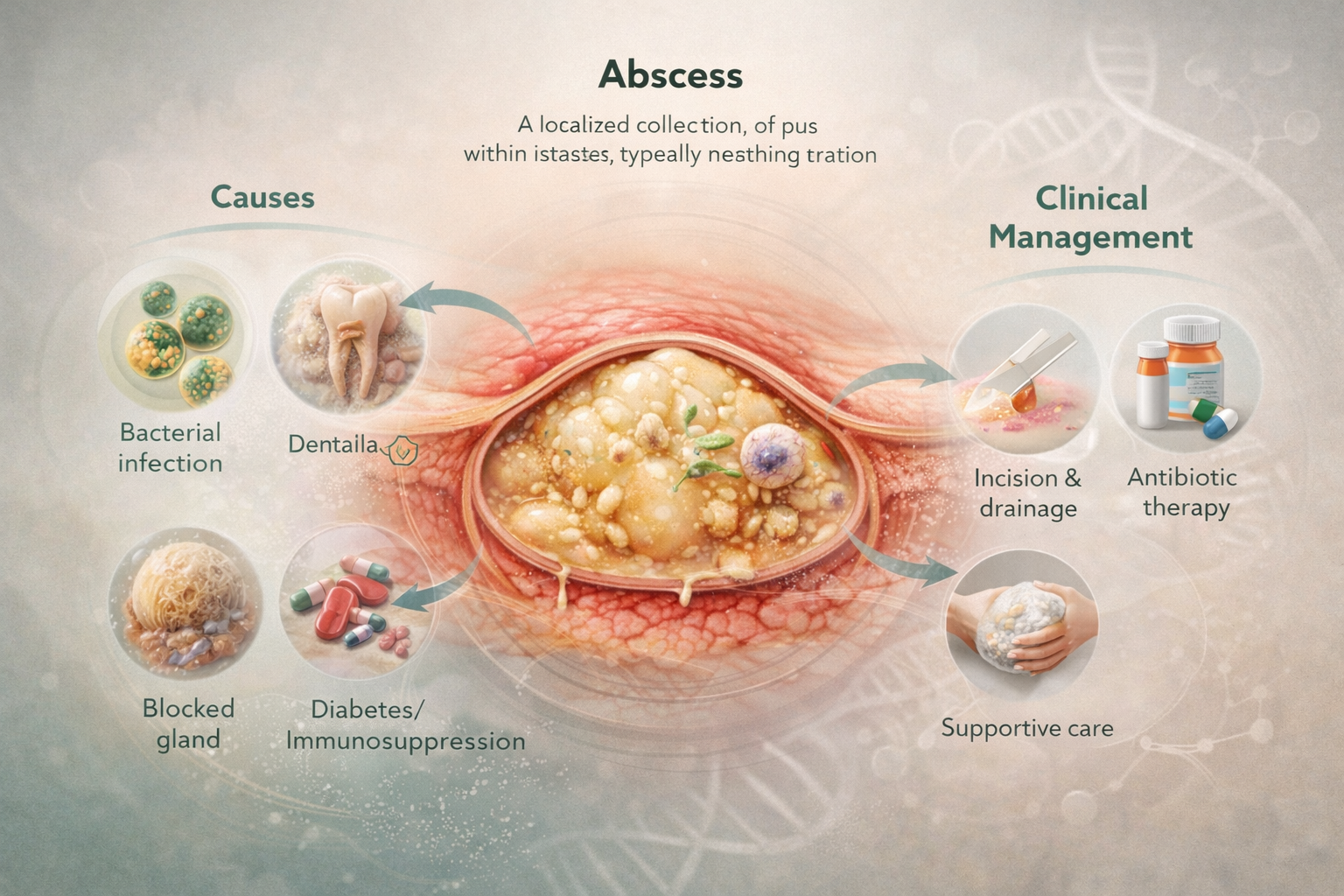
An abscess is a localized collection of pus within body tissue caused by an infection. This purulent accumulation occurs when the immune system responds to microorganisms, most commonly bacteria. Immune cells, particularly neutrophils, concentrate at the infection site to destroy pathogens. Their activity, combined with tissue breakdown and the presence of dead or living bacteria, produces a thick fluid called pus.
Abscesses typically develop within a cavity newly formed in the infected tissue. An inflammatory membrane may gradually surround this cavity, isolating the infection from surrounding healthy tissue. This containment limits bacterial spread but can sometimes prevent complete elimination.
Abscesses can occur in various tissues: skin, teeth, gums, internal organs, or muscles. Sizes range from a few millimeters to several centimeters. Common signs include pain, redness, warmth, and swelling. In some cases, fever or general malaise may appear.
Origin and Context of Use
The term “abscess” comes from the Latin abscessus, meaning “separation” or “withdrawal,” reflecting the biological phenomenon: the body isolates the infection from healthy tissue.
The concept of abscesses has been described since antiquity in the medical texts of Hippocrates, who mentioned pus collections requiring drainage. Medieval surgeons also performed incisions to evacuate these accumulations.
In modern medicine, the term refers to a localized infection forming a pus-filled cavity. It is relevant across multiple medical specialties: dermatology, surgery, dentistry, infectious diseases, and internal medicine.
It applies both to superficial abscesses visible on the skin and to deep abscesses within organs such as the liver, brain, or lungs. Advances in medical imaging have improved the detection of these internal forms.
How It Works
Abscess formation results from an immune response to a localized infection. The process usually begins when microorganisms penetrate tissue, often through a skin wound, dental infection, blockage of a glandular canal, or spread from an existing infection.
The most common bacteria involved belong to the genus Staphylococcus aureus, often found on the skin. When bacteria invade tissue, they trigger an inflammatory response. Immune cells, especially neutrophils and macrophages, migrate to the infected area in response to chemical signals called cytokines.
These cells attempt to phagocytose the bacteria. The resulting cell destruction, combined with necrosis of surrounding tissue, produces pus. Pus contains bacteria, cellular debris, proteins, and dead immune cells.
Over time, the body may form an inflammatory capsule around the purulent cavity. This barrier limits infection spread but sometimes prevents antibiotics from reaching the site effectively.
When internal pressure rises, the abscess may rupture spontaneously or require medical drainage to evacuate the pus.
When It Is Used
The term is used to describe several forms of localized infections in different parts of the body.
Skin abscesses often develop after an infection of a hair follicle, a minor wound, or skin irritation. They commonly appear in friction areas such as the armpits or buttocks.
Dental abscesses occur when a bacterial infection reaches the tooth pulp or surrounding tissues. They often cause intense pain and gum swelling.
Abscesses can also form in internal organs. Liver or lung abscesses usually result from bloodborne spread or from a nearby infection site.
Clinically, identifying an abscess guides treatment aimed at draining the purulent collection and addressing the associated bacterial infection.
Benefits and Objectives
Abscess formation represents a defense strategy of the body against infection.
Main physiological objectives:
✓ Isolate bacteria within a confined area to protect neighboring tissues
✓ Concentrate immune cells at the infection site
✓ Prevent microorganisms from spreading into the bloodstream
✓ Facilitate removal of infectious material through natural or medical drainage
This containment mechanism reduces the risk of systemic infection. Clinically, recognizing an abscess helps determine the need for drainage, which promotes rapid symptom resolution.
Risks, Limits, or Controversies
Untreated abscesses can cause several complications. Rising internal pressure may lead to rupture, allowing bacteria to spread to nearby tissues.
In some cases, infection can reach the bloodstream, causing a systemic infection called Sepsis, a medical emergency.
Deep abscesses are difficult to diagnose because symptoms may be nonspecific. Imaging, such as ultrasound or CT scan, is often required.
Antibiotics alone are sometimes insufficient because the inflammatory capsule limits drug penetration. Drainage remains essential in such cases.
Research and Innovations
Recent research focuses on improving the diagnosis and treatment of purulent infections. Medical imaging plays a crucial role in detecting deep abscesses through ultrasound, CT, or MRI.
Minimally invasive, image-guided drainage techniques allow evacuation of certain pus collections without open surgery, used for liver, abdominal, or pelvic abscesses.
Microbiological research targets antibiotic resistance. Certain bacterial strains, like Methicillin-resistant Staphylococcus aureus, complicate skin infection management.
Current studies aim to understand bacteria–immune system interactions better, optimizing therapeutic strategies.
Short FAQ
What is the pus inside an abscess?
Pus is a thick fluid made of dead immune cells, bacteria, cellular debris, and inflammatory proteins. It forms from the destruction of microorganisms and infected tissue by immune cells.
Can an abscess go away on its own?
Some small skin abscesses may drain spontaneously and heal without intervention. Larger or deeper abscesses usually require medical drainage to evacuate pus and prevent infection spread.
What are typical signs of a skin abscess?
Common signs include localized pain, redness, swelling, and warmth. A soft or fluctuant area may appear as the pus-filled cavity forms.
What is the difference between an abscess and a cyst?
An abscess is an infection containing pus. A cyst is a closed cavity filled with fluid or semi-solid material, usually not associated with bacterial infection.
Why is an abscess sometimes incised?
Incision evacuates accumulated pus, reducing tissue pressure, pain, and facilitating healing by removing infectious material.
Can an abscess cause fever?
Yes. A stronger inflammatory response may trigger fever, sometimes with fatigue or chills.
Are antibiotics enough to treat an abscess?
Antibiotics help control bacterial infection. If a purulent cavity is fully formed, drainage is usually required for proper healing.
Is an abscess contagious?
The abscess itself is not contagious. Some bacteria causing it can spread through direct contact with infected secretions or contaminated objects.
Which organs can be affected by an abscess?
Abscesses can form in many tissues: skin, teeth, gums, liver, lungs, brain, or muscles. Location depends on the type of infection and bacterial spread.
How can skin abscesses be prevented?
Good hygiene, prompt wound cleaning, and early treatment of skin or dental infections reduce the risk of abscess formation.
Scientific context
Field: Clinical medicine, biology, and preventive health
Biological process: Human physiology, pathology, and health-related mechanisms
Related systems: Metabolic, immune, cardiovascular, nervous, and cellular systems
Relevance to longevity: Understanding medical terminology and biological processes helps clarify how diseases, symptoms, biomarkers, and treatments influence long-term health, prevention, and healthy aging.
Key Takeaways
An abscess is a localized infection characterized by pus accumulation within a tissue cavity. It results from an immune response aimed at isolating bacteria and limiting spread. Abscesses can occur on the skin, teeth, or internal organs. Symptoms include pain, redness, and swelling. Treatment often involves pus drainage combined with antibiotics when bacterial infection is present. Early management reduces complications and promotes recovery.
Related Longevity Concepts