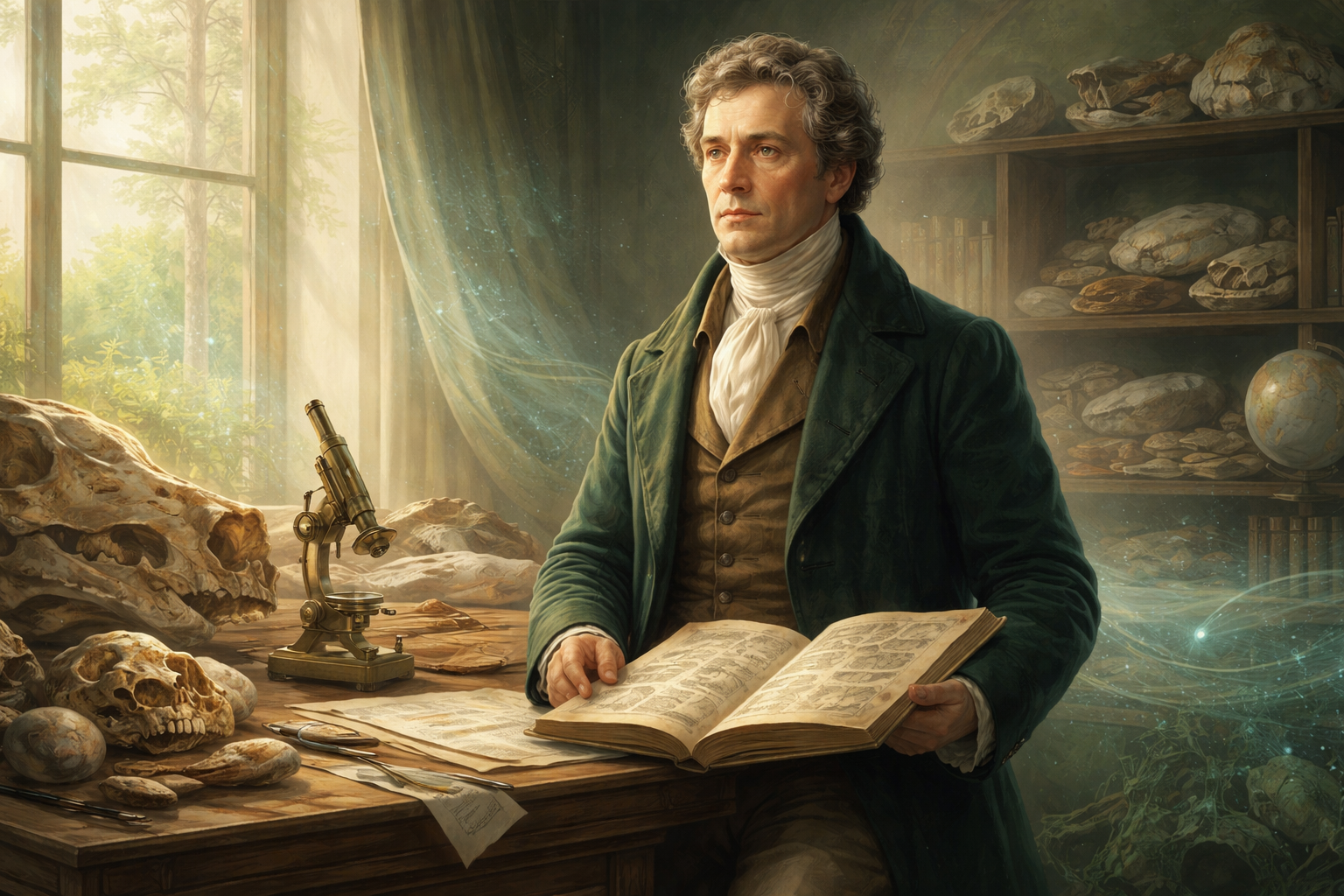
Georges Cuvier was a French naturalist and the founder of vertebrate paleontology. A leading figure at the Muséum national d’histoire naturelle in Paris, he demonstrated the reality of species extinction through fossil analysis. Although his work did not directly address human longevity, it fundamentally reshaped the scientific understanding of life’s structure, duration, and vulnerability across geological time.
At the turn of the nineteenth century, Georges Cuvier established a scientific method that transformed natural history. Born in 1769 and deceased in 1832 in Paris at the age of 62, he built his reputation on rigorous observation and comparative anatomy. In an era still influenced by speculative philosophies of nature, he insisted on structural evidence and empirical demonstration. His intellectual energy focused on a decisive question: how can we understand living organisms through their fossilized remains.
By studying bones extracted from the quarries of the Paris Basin, he showed that certain species no longer existed. In his Discours sur les révolutions de la surface du globe, he wrote that “life has often been disturbed on this earth by terrible events,” articulating his theory of catastrophism. Life, in his framework, became a historical phenomenon shaped by disruption.
The journey

Georges Cuvier was born in Montbéliard and educated in Germany, where he developed a strong foundation in natural sciences. His move to Paris in 1795 marked a decisive turning point. Appointed to the Muséum national d’histoire naturelle, he quickly distinguished himself through his work in comparative anatomy. He formulated the principle of the correlation of parts, arguing that each organ of an organism is functionally connected to the whole. From a single bone fragment, he claimed he could reconstruct an entire animal.
This methodological rigor enabled him to identify unknown fossil species and to assert that some had disappeared completely. At a time when extinction was still widely disputed, this conclusion was groundbreaking. Cuvier gained considerable scientific and political influence, holding key administrative roles under both the Napoleonic regime and the Bourbon Restoration. His authority placed him at the center of debates on the nature of species, particularly in opposition to Jean Baptiste Lamarck’s transformist ideas. Until his death in 1832, he remained deeply engaged in research and institutional leadership.
His vision of longevity
Cuvier did not conceptualize longevity at the level of the individual organism but at the scale of species and biological organization. His approach was structural and fixist. He considered each species to be a coherent system governed by an integrated anatomical plan. Any substantial modification would disrupt this equilibrium and threaten survival. Consequently, he rejected the notion of gradual transformation of species over time. Confronted with fossil evidence, he interpreted discontinuity rather than progressive evolution. In Discours sur les révolutions de la surface du globe, he observed that “life on the earth has often been disturbed by terrible events.” Catastrophic natural phenomena, in his view, caused mass extinctions, followed by the emergence of new faunas. Biological duration was therefore episodic, dependent on fragile balances between internal organization and environmental stability.
In his Leçons d’anatomie comparée, he emphasized that “the organization is a whole in which all the parts mutually correspond.” This systemic understanding anticipates later holistic approaches in biology. Although later evolutionary theory would challenge his fixism, Cuvier established a critical principle for thinking about longevity: survival over time depends on structural coherence and environmental resilience. His work reframed life not as an uninterrupted continuum but as a succession of biological configurations shaped by crisis and reconfiguration.
His influence and impact
Cuvier’s influence on nineteenth century science was profound. He institutionalized comparative anatomy and established vertebrate paleontology as a rigorous discipline. By demonstrating extinction, he permanently altered conceptions of geological and biological time.
His catastrophist model generated intense debate, particularly as evolutionary theory gained prominence later in the century. While strict catastrophism was eventually refined, his methodological discipline and structural analysis remained foundational. In contemporary discussions about biodiversity loss and planetary crises, the idea that environmental upheavals can reshape life on Earth resonates strongly with his work. Modern reflections on mass extinction events echo, in different scientific terms, his early recognition that life’s continuity is neither guaranteed nor linear.
Fragiel continuity of life?
Georges Cuvier did not seek to extend human lifespan or theorize aging. Yet by situating life within a history of disruption and extinction, he transformed the understanding of biological duration. His perspective reminds us that longevity is contingent upon structural integrity and environmental balance. At a time when longevity sciences explore resilience at molecular, organismal, and ecological levels, Cuvier’s legacy invites a broader reflection: the persistence of life depends not only on internal mechanisms but also on the stability of the world it inhabits, a question that remains open.