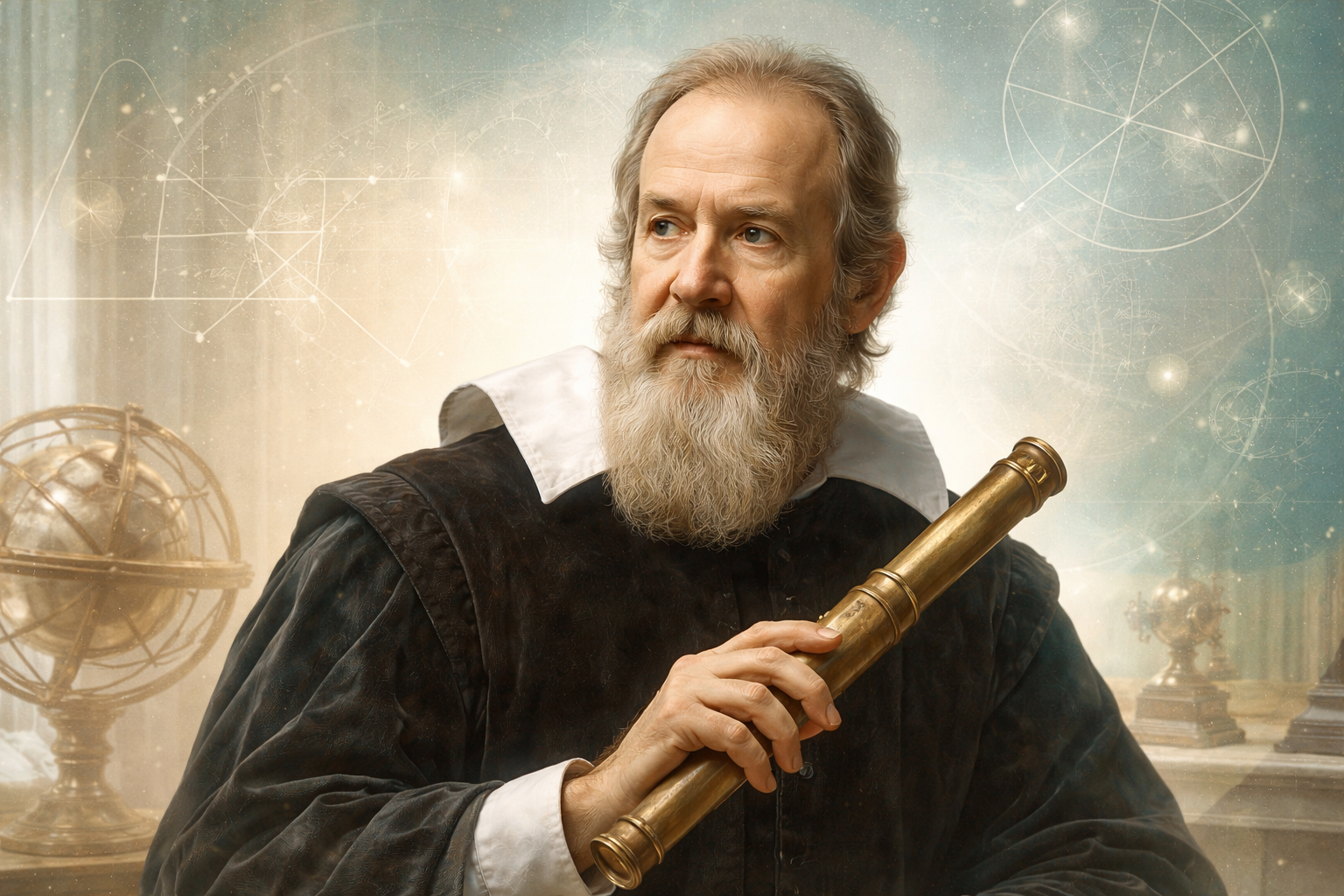
Galileo Galilei is a foundational figure of modern science, known for profoundly transforming the way the world is observed and understood. An astronomer, physicist and philosopher, he is now considered one of the first scientists to apply a rigorous experimental method. His work is essential for longevity because he laid the foundations of modern science, a prerequisite for any medical or biological progress.
Galileo was not simply a Renaissance scholar. He represents an intellectual rupture. At a time when knowledge was still largely based on the authority of ancient texts, he defended a radical idea: scientific truth should not be inherited, it should be observed. His intellectual energy was built around a simple but revolutionary conviction. The world can be measured. Time can be studied. Motion can be understood. This vision transformed science into a tool for understanding the living world, and therefore indirectly the foundations of human longevity.
The journey
Galileo’s path does not resemble that of a modern scientist. Born in Pisa in 1564, he initially studied medicine before turning toward mathematics. Very early on, he became fascinated by the measurement of time and the movement of objects. He famously observed the oscillation of a chandelier in a cathedral and understood that the movement of a pendulum follows a measurable regularity. This insight marked the beginning of a body of work that would transform physics.
His career took a decisive turn when he began using the telescope. Contrary to popular belief, he did not invent the instrument, but he significantly improved its precision. Thanks to this, he observed the mountains of the Moon, the satellites of Jupiter and the phases of Venus. These discoveries directly challenged the worldview inherited from Aristotle. This was the moment when Galileo became a public figure. His name moved beyond scientific circles and became the symbol of a new way of thinking.
His vision of longevity
Galileo obviously did not approach longevity through modern biology. His vision was built on a deeper idea: understanding the laws of nature makes it possible to extend human knowledge, and therefore indirectly human life. For him, science should not be speculative. It must be measurable, verifiable and reproducible. This approach now sits at the very core of all modern research on aging.
In one of his most famous writings, he explains that nature can only be understood through mathematics. This statement may appear abstract, but it is actually fundamental for modern medicine. Biological models, medical statistics and the study of cellular aging all rely on the same principle: nature follows measurable laws. Galileo challenged a static vision of the world and opened the way to a dynamic science capable of evolving.
He also defended an essential idea for modern longevity science: progress comes from questioning. For him, authority alone is not enough. Only experimentation makes it possible to understand reality. This philosophy directly influenced the scientific methods used today in aging research. Clinical trials, experimental protocols and data evaluation all rely on this logic.
Influence and impact
Galileo’s influence extends far beyond physics and astronomy. He changed the way science is structured. He transformed the scholar into an experimental scientist. He established the idea that knowledge must be tested rather than simply transmitted. This transformation still structures medical research and longevity research today. Without this intellectual rupture, it would be difficult to imagine modern advances in the understanding of aging.
His influence also continues to generate debate. Some historians believe that his role has been amplified by the history of science. Others believe that he is still underestimated, particularly in his impact on the scientific method. This debate highlights one essential point: Galileo is not only a figure of the past. He remains active in the way we think about science today.
A method that made modern longevity possible
Galileo Galilei did not speak about longevity in the modern sense of the term. Yet his influence on science is direct. By transforming the way the world is observed, he made all future scientific progress possible. Modern longevity does not rely only on biology. It relies first on a method. And that method begins with him. The real question that remains open is this: which scientific breakthrough today could play the same role for the next hundred years.