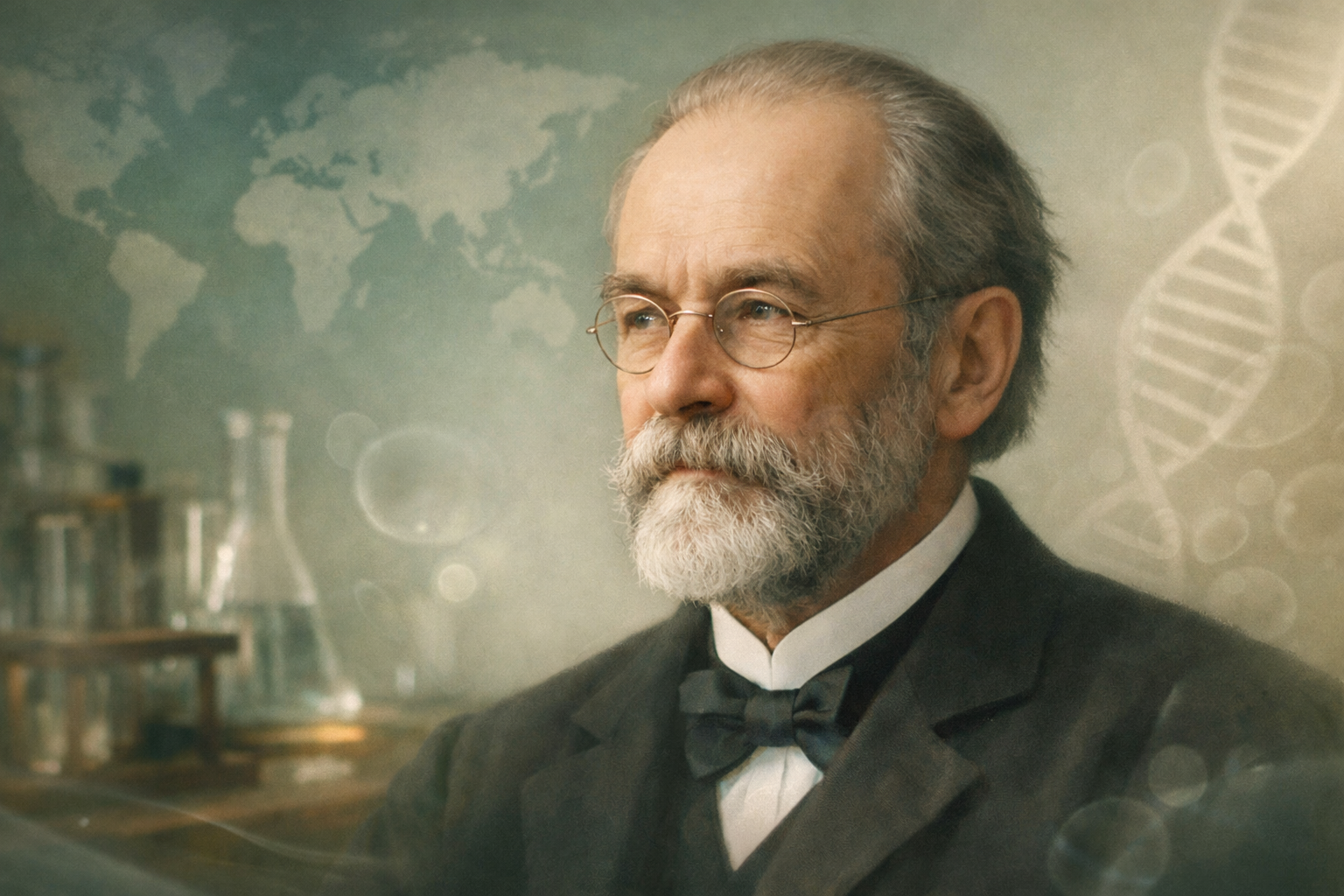
Émile Roux was a French physician and microbiologist who played a central role in the development of modern microbiology at the end of the nineteenth century. A close collaborator of Louis Pasteur, he contributed significantly to the discovery of bacterial toxins and to the development of serum therapy. His research helped transform experimental medicine into a practical tool for disease prevention and treatment, laying scientific foundations that would significantly extend human life expectancy.
At the intersection of medicine and experimental research, Émile Roux represents a generation of scientists who fundamentally reshaped the understanding of disease. Born in 1853 in the Cantal region of France, he joined Louis Pasteur’s laboratory at a time when the germ theory of disease was challenging long-held medical beliefs. Roux quickly became more than a collaborator. He emerged as one of the quiet yet decisive architects of the Pasteurian revolution.
Working in the Paris laboratories of the late nineteenth century, Roux developed a rigorous approach to microbiology grounded in experimentation and observation. His scientific ambition was clear: to understand the invisible mechanisms responsible for disease in order to neutralize them. This vision reflected a broader scientific ethos of the era, captured in a phrase associated with the spirit of his work: “Science knows no country.” The idea reflects the universality of medical knowledge and the shared global effort to combat disease.
The journey
Émile Roux’s scientific path began during a period of profound transformation in medicine. After studying medicine in Clermont-Ferrand and later in Paris, he joined Louis Pasteur’s laboratory in the early 1880s. At that time, microbiology was still an emerging field. Researchers were only beginning to demonstrate that microscopic organisms could be responsible for human diseases.
Within Pasteur’s laboratory, Roux contributed to several pivotal experiments. Among them were early investigations into rabies, including work related to the experimental vaccine that would later become one of the most celebrated achievements of Pasteur’s research. Yet Roux’s most influential work would come through his study of bacterial toxins.
During the 1880s and 1890s, he conducted pioneering research on diphtheria, a disease that was particularly deadly among children. In collaboration with other European scientists, Roux demonstrated that the bacteria responsible for diphtheria produced a toxin that triggered the severe symptoms of the disease. This discovery opened the door to an entirely new therapeutic strategy.
In 1894, Roux publicly presented the results of diphtheria antitoxin serum therapy. The treatment relied on antibodies produced in animals to neutralize the toxin circulating in the patient’s body. Mortality rates among infected children dropped dramatically. The breakthrough became a landmark moment for experimental medicine and helped establish the Institut Pasteur as a global center for biomedical research.
His vision of longevity
Although the modern concept of longevity did not yet exist in Roux’s time, his research contributed directly to the extension of human life expectancy. His scientific philosophy rested on a principle that was revolutionary for nineteenth-century medicine: diseases must be understood at their biological root in order to be effectively prevented or neutralized.
The development of serum therapy illustrates this approach. Instead of merely addressing symptoms, Roux sought to intervene in the underlying biological mechanism of disease. By identifying toxins produced by bacteria, he demonstrated that the human body could be protected through a targeted immune response. This conceptual framework would later inspire the development of vaccines, immunology, and modern antibody-based therapies.
In lectures delivered at the Institut Pasteur, Roux often emphasized the universal nature of scientific progress. The phrase “Science knows no country” reflects a belief widely shared among scientists of his generation: medical discoveries should transcend borders and benefit humanity as a whole.
His work also helped redefine medicine as an experimental science. For Roux, clinical observation alone was no longer sufficient. Biological phenomena had to be reproduced, tested, and analyzed within controlled laboratory environments. This methodological shift became a cornerstone of modern biomedical research.
By developing diphtheria antitoxin therapy, Roux helped transform the relationship between medicine and prevention. The goal was no longer solely to treat disease after it appeared, but to anticipate and neutralize it through scientific intervention. This transformation would become one of the major drivers of the dramatic increases in life expectancy observed during the twentieth century.
Influence and impact
The influence of Émile Roux extended far beyond his individual discoveries. As director of the Institut Pasteur in the early twentieth century, he played a key role in structuring international microbiological research. The institute became a leading training center for scientists arriving from across the world.
His research on bacterial toxins profoundly influenced the development of immunology. Understanding how microbes interact with the immune system opened the way to numerous medical innovations, particularly in vaccination and infectious disease prevention.
The introduction of diphtheria serum therapy also marked a turning point in public health. For the first time, a treatment developed through experimental laboratory research was deployed on a large scale to reduce mortality. This moment symbolized the transition from empirical medicine to evidence-based biomedical science.
Today, the scientific principles established by Roux remain central to modern medical research. The study of toxins, antibodies, and immune responses continues to shape therapeutic innovation across fields ranging from infectious disease to biotechnology.
From microbial discovery to modern longevity
Émile Roux belongs to the generation of scientists who transformed medicine into a rigorous experimental discipline. His research on diphtheria and bacterial toxins helped reduce childhood mortality and laid important foundations for modern immunology.
More broadly, his work reflects a historical turning point when the understanding of microbes became a powerful driver of public health progress. The scientific advances of this period played a major role in extending human life expectancy throughout the twentieth century.
At a time when biotechnology and immunotherapy are opening new possibilities for the future of medicine, the legacy of Émile Roux reminds us that the great transformations of longevity often begin quietly in the laboratory.