Key information
- Amphoteric surfactant is used to gently cleanse the skin and scalp
- Works by reducing surface tension while preserving the hydrolipidic film
- helps limit mild inflammation associated with aggressive cleansing
- Useful in a routine aimed at balancing the skin barrier
- Dermatological studies show better skin tolerance compared to other sulfate surfactants
In the world of conscious longevity, skin health plays an essential role. As a barrier organ, it often reflects internal cellular balance. Certain ingredients, although overlooked, play a key role in preserving this balance. Cocamidopropyl hydroxysultaine is one such technical compound, often found in modern cleansing products.
Although it is not an anti-aging active ingredient in the traditional sense, it can indirectly contribute to skin vitality by supporting hygiene that respects the microbiome and the natural protective film. In this article, we will study its role, which will allow for a more informed approach to daily skincare, with a view to long-term health.
What is it ?
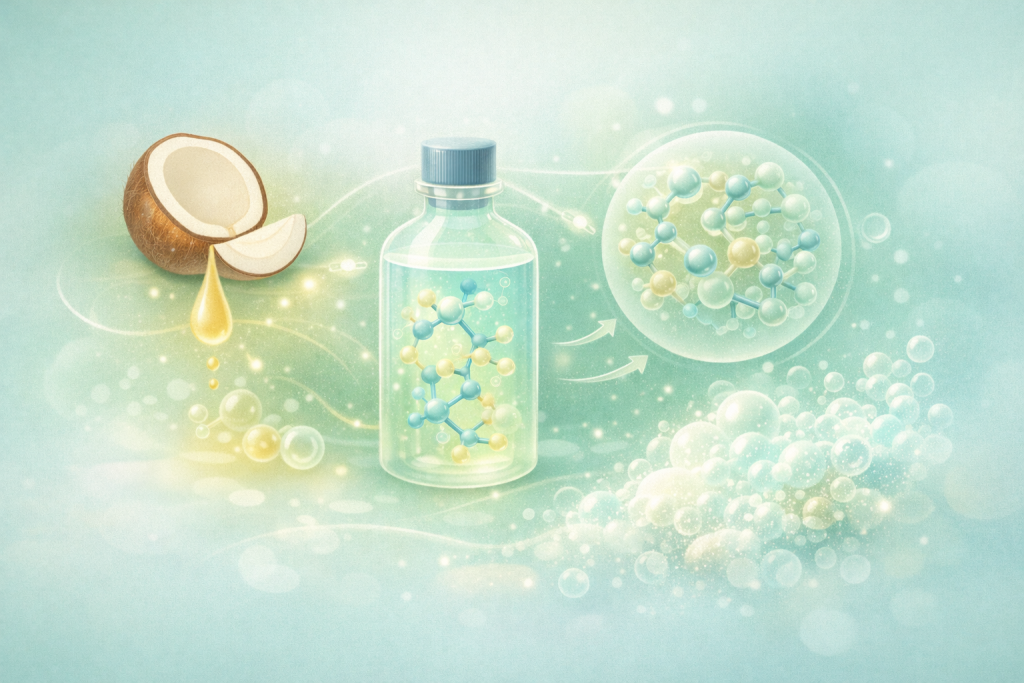
Cocamidopropyl hydroxysultaine is an amphoteric surfactant from coconut fatty acids. It is obtained by chemically modifying a plant-based lipid base, which gives it a natural affinity for lipid membranes.
Its biological role is functional as it solubilizes fats and impurities while forming a stable, gentle lather.
Its unique feature is its amphoteric nature because it can behave as a cationic or anionic agent depending on the pH, which contributes to its compatibility with the skin and mucous membranes.
Did you know
Amphoteric surfactants such as cocamidopropyl hydroxysultaine are often used to reduce the irritant potential of formulations containing more powerful cleansing agents.
How does it work ?
Main Action
Its mechanism involves reducing the tension of the water’s surface. It surrounds the fatty particles and impurities to form micelles, making them easier to rinse away.
Thanks to its zwitterionic structure, it can interact more harmoniously with the proteins in the stratum corneum, which can help limit the protein denaturation observed with certain strong anionic surfactants.
Effects at the tissue level
Skin
It can help cleanse the hydrolipidic film, which is key to protecting against dehydration and mild inflammation.
Scalp
In limiting chemical aggression, it supports an environment favorable to the balance of the skin microbiome.
Skin barrier
Less aggressive cleansing can indirectly help preserve the integrity of intercellular lipids, which are essential for cell cohesion.
What does it mean in terms of longevity
In an approach to skin longevity, preserving the barrier and limiting repeated micro-aggressions can support long-term cellular vitality. A suitable cleansing routine contributes to the overall balance of tissues exposed to environmental stress on a daily basis.
Study box
2019 – Comparative in vitro and in vivo study
Type of study: dermatological evaluation of skin tolerance (Journal of Surfactants and Detergents)
Key result: Amphoteric surfactants showed lower irritation potential than conventional sulfate surfactants in standard skin models.
Benefits
Gentle cleansing
Mild surfactants reduce disruption to the skin’s lipids and limit insensible water loss.
This translates into a feeling of comfort after washing, particularly for sensitive or mature skin.
Support for the skin barrier
By limiting the alteration of surface proteins and lipids, it helps maintain a balanced skin environment.
In a longevity routine, this promotes more supple skin that is less reactive to repeated aggressions.
Suitable for high-tolerance treatments
Its compatibility with different pH levels allows it to be incorporated into products intended for sensitive areas.
It is therefore frequently used in shower gels, facial cleansers, and hair care products designed to be gentle on the skin.
Natural sources
Cocamidopropyl hydroxysultaine can be found in coconut oil, vegetable fatty acids, modified amine derivatives, and stabilized sulfonated agents.
Dosage, forms & bioavailability
As it is a cosmetic ingredient, it is dedicated to skin use only.
Usual concentrations vary between 3 and 15% depending on the type of formula.
It can be found in liquid form and is mostly integrated into cleansing bases.
It can be combined with complementary nonionic or amphoteric surfactants.
Cocamidopropyl hydroxysultaine is suitable for daily use in balanced formulas.
Its action depends mainly on the contact time and the overall quality of the formulation.
Safety & precautions
Cocamidopropyl hydroxysultaine has a good skin tolerance profile when properly formulated. Side effects such as mild irritation are possible highly reactive skin.
People prone to dermatitis should choose dermatologically tested formulas and seek advice from a healthcare professional.
How to integrate it into a longevity routine ?
When to use it
In everyday cleansing products such as shower gel, facial cleanser, or shampoo.
Possible combinations
Cocamidopropyl hydroxysultaine can be used along with ceramides, glycerin, panthenol, and lipid-replenishing agents. These combinations can support skin hydration and balance.
Exemple de routine simple
In the morning, proceed as follows :
- Gentle cleansing
- Moisturizing serum
- Sun protection
In the evening, proceed as follows:
- Gentle cleansing
- Nourishing barrier treatment
For whom is it particularly interesting ?
For individuals with sensitive mature skin, reactive scalps, or people looking for gentle, regular hygiene.
A gentle ally for maintaining skin balance over time?
In a conscious approach to longevity, every action counts. Cleansing is a fundamental pillar of skin health. Cocamidopropyl hydroxysultaine helps preserve a stable and respectful skin environment.
By limiting repeated damage and supporting the natural barrier, it indirectly contributes to the vitality of tissues exposed on a daily basis. A gentle, consistent, and sustainable strategy that promotes skin balance that works over time.
Sources
- Ananthapadmanabhan, K. P. (2004). Cleansing without compromise: understanding surfactant irritation. Dermatologic Therapy.
- Walters, R. M., et al. (2012). Cleansing formulations and skin barrier function. Journal of Cosmetic Science.
Seweryn, A. (2018). Interactions between surfactants and skin proteins. Journal of Surfactants and Detergents.