Key points
Clitoria ternatea is rich in anthocyanins, powerful antioxidants.
It can help protect cells from oxidative stress.
It is associated with gentle support for cognitive function and mental vitality
Used in infusions, it contributes to a soothing wellness routine.
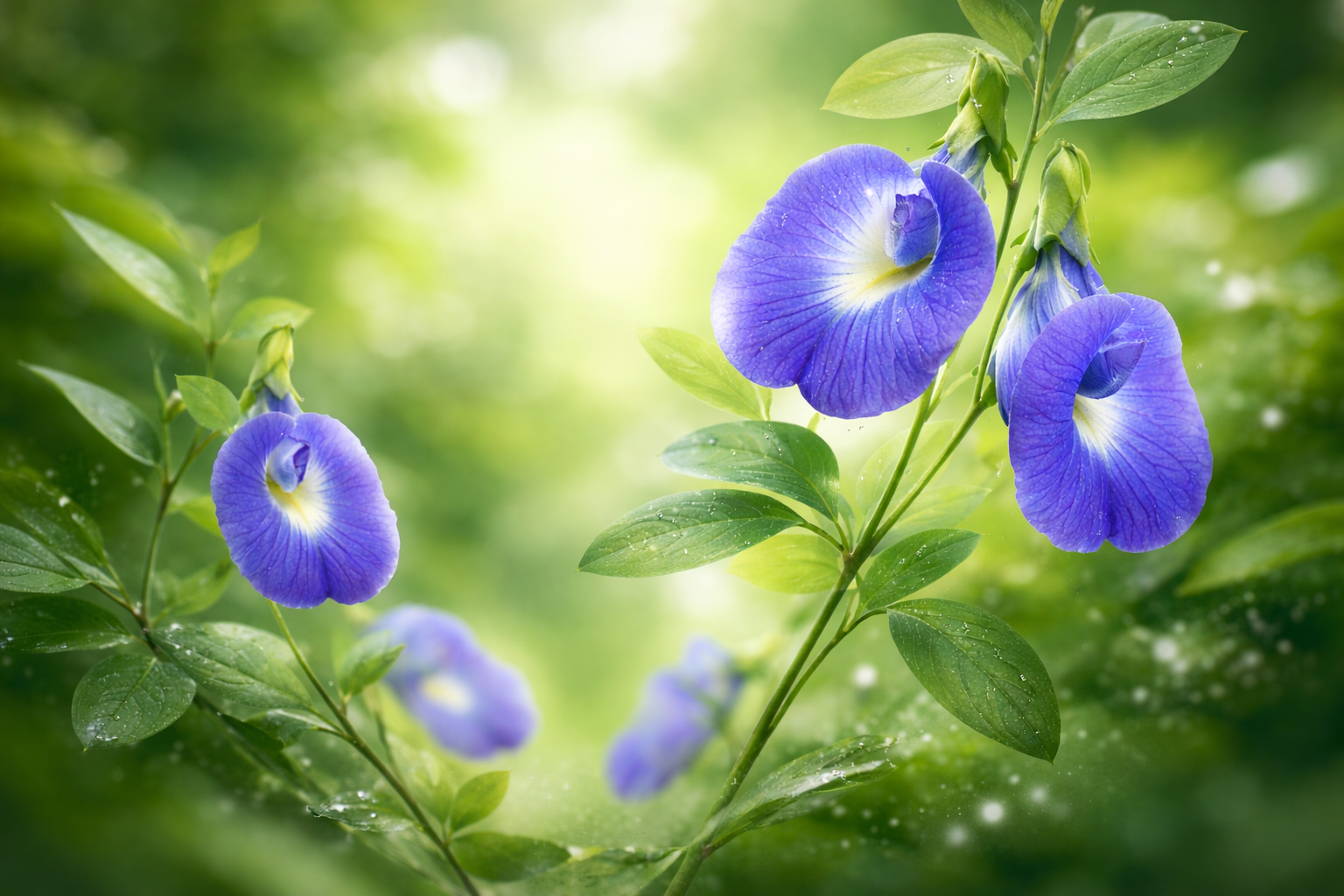
Clitoria ternatea, also known as blue pea or butterfly pea, is currently attracting the attention of scientific researchers. Its deep blue color reveals an exceptionally high antioxidant content.
In a context where conscious longevity relies on cellular protection, balanced mild inflammation, and the preservation of cognitive functions, this flower is attracting growing interest.
What does science really say ? How does it work at the cellular level ? And can it be integrated into a sustainable health routine ? Let’s explore its mechanisms with nuance and serenity.
What is it?
Clitoria ternatea is a climbing plant native to tropical Asia, belonging to the Fabaceae family.
Its distinctive feature is its intense blue flowers, rich in specific anthocyanins called ternatins. These pigments are responsible for its vibrant color and antioxidant properties.
Traditionally, it is used in infusions to support mental clarity, promote a state of calm, and support the body’s overall balance.
Biologically, its active compounds may interact with mechanisms related to oxidative stress and cell signaling.
Did you know?
The ternatins in Clitoria ternatea are particularly stable anthocyanins, which could explain their prolonged antioxidant potential compared to other plant pigments.
How does it work?
Main action
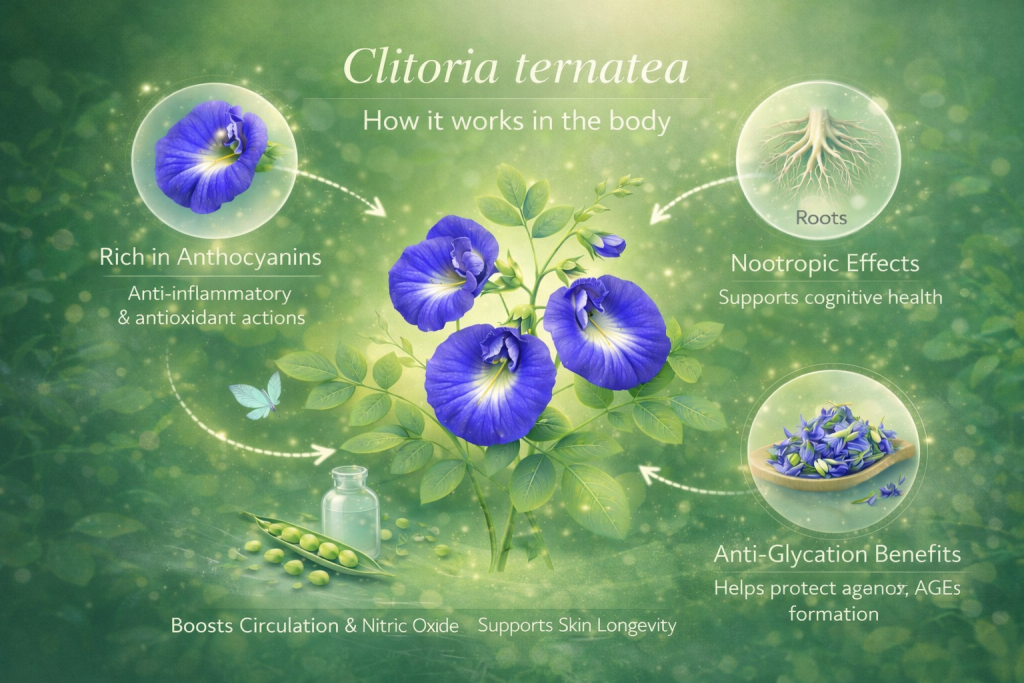
The anthocyanins present in the flower may help neutralize certain free radicals.
By supporting oxidative balance, they may help protect cell membranes and mitochondrial structures, which are key components of cellular energy.
Effects on tissues
In the brain, some data suggest modulation of neurotransmitters involved in memory and attention.
At the systemic level, its compounds may support balanced mild inflammation, which is beneficial for long-term health.
Its high flavonoid content may also contribute to vascular protection.
What this means for longevity
By helping to protect cells from oxidative stress and supporting cognitive function, Clitoria ternatea may support mental vitality over time.
It does not aim for dramatic results, but rather gradual support for cellular balance.
Study focus
2015 – Randomized clinical trial
Study conducted in healthy adults evaluating the impact of Clitoria ternatea extract on memory and cognitive performance.
Key result : a moderate improvement in certain working memory parameters was observed after several weeks of use.
Benefits
Gentle cognitive support
Preclinical studies suggest neuroprotective activity linked to anthocyanins and flavonoids.
In practical terms, this can translate into a more stable feeling of mental clarity, particularly during periods of cognitive fatigue.
Antioxidant protection
Oxidative stress is associated with cellular aging. The polyphenolic compounds in the flower may help to limit this phenomenon.
In practice, this can support overall balance, especially in the context of a demanding lifestyle.
Emotional balance
Traditionally, the plant is used to promote a state of calm.
With no marked sedative effect, it can be incorporated into an evening routine to aid relaxation.
Natural sources
- Dried flowers for infusion
- Micronized powder
- Standardized extracts
- Functional botanical blends
Dosage, forms & bioavailability
Human studies generally use standardized extracts between 200 and 500 mg per day.
For infusions, 1 to 2 grams of dried flowers steeped in hot water for 5 to 10 minutes are commonly used. Combining it with vitamin C or other polyphenols may support the stability of anthocyanins.
Use over several weeks is generally studied to observe measurable effects.
Safety & precautions
Clitoria ternatea has a generally favorable tolerance profile at traditional doses.
Mild digestive problems may occasionally occur at high doses.
As a precaution, its use is not recommended for pregnant or breastfeeding women, or for those undergoing medical treatment without professional advice.
Support from a healthcare professional is recommended for a personalized approach.
How to incorporate it into a longevity routine
When to take it
In the morning for cognitive support, or at the end of the day to promote a state of calm.
What to combine it with :
- Magnesium for nervous system balance
- Omega-3 for brain health
- Complementary polyphenols (green tea, blueberry)
Example of a simple routine
Flower infusion in the morning, combined with a diet rich in antioxidants and a lifestyle that supports mitochondrial vitality.
Who is it particularly beneficial for :
- People exposed to mental stress
- Adults who want to support their memory
- Anyone committed to a conscious longevity approach
A blue flower to accompany vitality over time?
Discreet and elegant, Clitoria ternatea illustrates the idea of lasting health built on subtle but regular support. By contributing to cellular protection and mental clarity, it can be part of a holistic approach to longevity that prioritizes balance, gentleness, and consistency over the long term.
Integrated into a mindful routine, it reminds us that vitality does not depend on spectacular effects, but on an accumulation of calm and informed choices.
Sources
Mukherjee, P. K., et al. (2008). Evaluation of brain function of Clitoria ternatea. Journal of Ethnopharmacology.
Pratap Chandran, R., et al. (2015). Cognitive effects of Clitoria ternatea extract in healthy volunteers.
Lakshmi, V., et al. (2014). Antioxidant and neuroprotective properties of Clitoria ternatea.
Oguis, G. K., et al. (2019). Anthocyanin stability and antioxidant activity in butterfly pea flower. Food Research International.