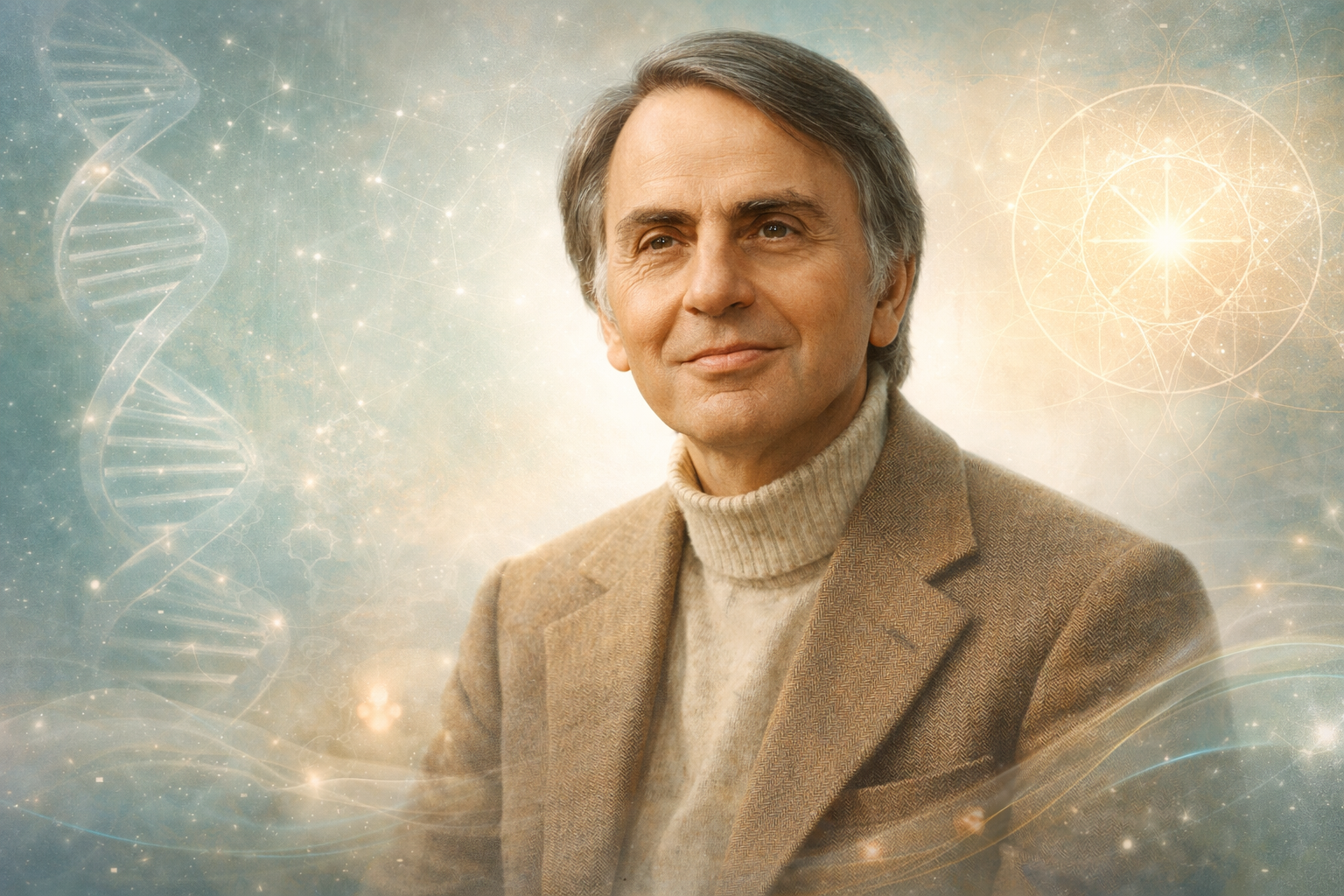
Carl Sagan was an American astrophysicist, astronomer, and science communicator, author of numerous books and creator of the Cosmos series. He is best known for making science accessible to tens of millions of people by exploring the universe, humanity’s place within it, and the nature of knowledge. Although he was not directly active in medical research or human longevity, his work fostered critical thinking and curiosity about the natural sciences, indirectly supporting a culture that values scientific knowledge and innovation.
Astronomer and brilliant communicator, Carl Sagan became one of the most influential science popularizers of the 20th century. Through his books and the Cosmos series, he brought science into households worldwide, fostering a broader understanding of the universe and humanity’s place within it. His ability to connect scientific inquiry with existential questions has left a lasting mark on generations and significantly shaped scientific culture.
Carl Sagan, with his gentle voice and attentive gaze, was not only a scientist but a conduit of meaning. Born in 1934 and passing away in 1996, he devoted his life to exploring the stars and sharing these discoveries with the public. His energy was that of a passionate curiosity, firmly believing that science should be understood by all, not confined to an academic elite. He sought to bring humanity closer to the wonders of the cosmos while highlighting the fragility of our planet and the importance of critical thinking. Cosmos made him an iconic figure in global scientific culture, inspiring generations to think rigorously while nurturing a sense of awe at the natural world.
Career
Carl Edward Sagan was born in 1934 in Brooklyn, New York. From a young age, he was fascinated by stars and science, leading him to study physics and astronomy at university. After earning a Ph.D. in sciences, he joined NASA’s Jet Propulsion Laboratory, contributing to robotic missions to Mars and Venus. In the 1970s, he became a professor at Cornell University and began writing books for a general audience. Cosmos: A Personal Voyage (1980), both a book and a television series, brought him international fame, captivating millions by linking science and humanity. Sagan also worked on concrete scientific projects, including studying Venus’ atmosphere and the potential presence of water on moons in the solar system. Simultaneously, he engaged in public debates, opposing nuclear weapons and warning about climate change.
His vision of longevity
Carl Sagan did not articulate a “vision of longevity” in a biomedical sense, but his thinking deeply resonates with human concerns about the duration and quality of life. In Cosmos, he played with cosmic timescales to remind us how brief human life is compared to the vastness of the universe: “The lifetime of a human being is measured in decades; the lifetime of the Sun is millions of times longer…” he noted, inviting reflection on our own existence. For Sagan, science was not just a body of facts but a tool to deepen our understanding of life and our place within it, freeing the mind from illusions and promoting a clear-eyed grasp of the human condition. He also emphasized the importance of maintaining a critical mind, stating, “Science is a process that corrects itself,” underscoring the necessity of rigorous evidence, especially in areas influenced by human belief and desire.
Influence and impact
Carl Sagan’s impact extended far beyond science popularization: he helped shape a culture in which science is seen as accessible and relevant, inspiring careers and vocations in science. His approach presented science as a human adventure, open and without dogma, continuing to inspire educators and scientists today. While some may debate the extent of his influence in highly specialized fields like biotechnology or medicine, his legacy in terms of ways of thinking and relating to knowledge remains profound.
Reflections on legacy
Carl Sagan was not a researcher in human longevity, yet he profoundly contributed to cultivating an informed relationship with knowledge, essential for any reflection on life, its duration, and its quality. By placing humanity in a vast cosmic context, he encourages curiosity and critical thinking, pillars of a society capable of advancing toward a more sustainable future. His legacy remains relevant: in a world facing major scientific and ethical challenges, Sagan reminds us that understanding the cosmos is also a way to better understand our own existence and the fragile miracle of life.