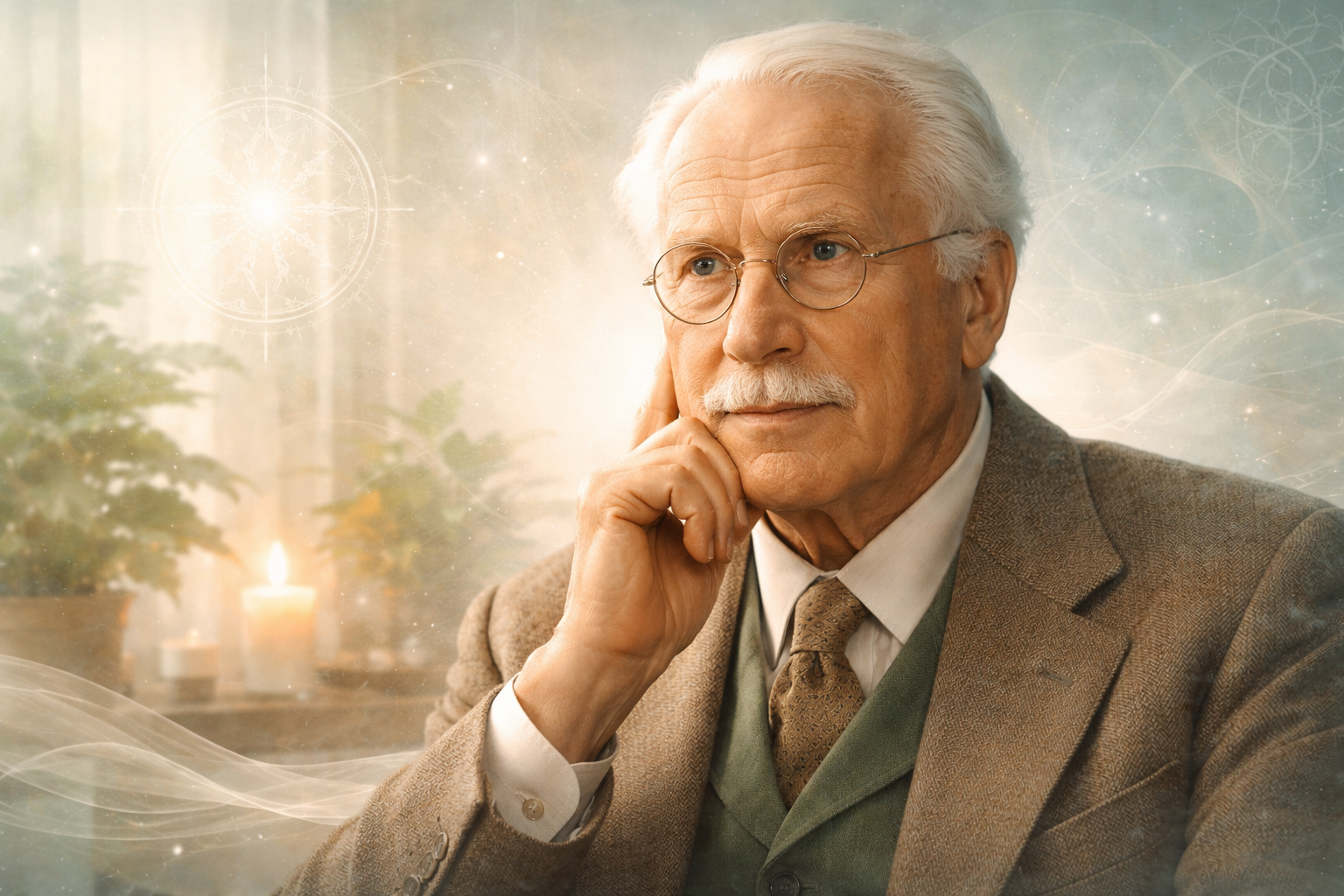
Carl Jung was a Swiss psychiatrist and psychologist best known for founding analytical psychology and reshaping the understanding of the human mind. A major figure of the twentieth century, he profoundly influenced modern mental health thinking. His work remains central to contemporary reflections on psychological longevity, emotional resilience, and inner balance, three dimensions now considered essential for living longer in good health.
There are thinkers who shape a discipline, and others who transform the way an entire society understands itself. Carl Jung belongs to the second category. His trajectory does not belong solely to the history of psychiatry. It also touches a deeper question, the duration of inner life. While medicine has long tried to extend the body, Jung focused on what allows the mind to remain alive, evolving, and capable of transformation. His thinking is based on a powerful idea: a long life cannot truly be sustainable without a conscious inner life. As he wrote in one of his most quoted statements, “Who looks outside dreams; who looks inside awakens.” This sentence captures his approach. Longevity is not only biological, it is also psychological.
The journey
Carl Jung’s path begins in Switzerland at the end of the nineteenth century, in an environment deeply shaped by religion and introspection. Very early on, he became interested in psychic phenomena, symbolism, and the invisible mechanisms that structure human behavior. His career took a decisive turn when he entered the medical world and began working in psychiatry. He quickly gained attention for his research on word associations and the unconscious, a field that was still largely ignored at the time. His encounter with Sigmund Freud accelerated his international visibility. For several years, Jung appeared to be the natural successor of psychoanalysis. But their break became a defining moment. Where Freud emphasized instincts and the individual past, Jung opened a broader perspective. He introduced the idea of a collective unconscious shared by humanity and developed a much wider vision of psychological development. This separation, rather than slowing his career, placed him at the center of a new intellectual movement. From that point on, Jung built a body of work that went beyond traditional psychiatry and reached philosophy, spirituality, and the psychology of aging.
His vision of longevity
Carl Jung’s vision of longevity is based on a simple but radical conviction: the length of life only has meaning if it is accompanied by inner transformation. He did not speak directly about biological longevity as contemporary researchers do, but he was deeply interested in what allows individuals to continue evolving with age. For him, the second half of life is not a decline but a stage of construction. He argued that psychological maturity can become richer over time, as long as individuals are willing to confront their unconscious. He summarized this idea in a sentence that has become central in modern personal development approaches: “Until you make the unconscious conscious, it will direct your life and you will call it fate.” This quote reflects a key idea for psychological longevity. Living longer is not enough; understanding what drives us is essential. Jung also questioned a purely medical definition of health. He insisted on the need for balance between body and mind, but also between consciousness and what he called the shadow. According to him, ignoring one’s fragilities does not strengthen mental health; it weakens it over time. From this perspective, longevity becomes a process of self-knowledge. What he ultimately proposes is a vision of lifespan based on continuous transformation. Aging is not a loss. It is a possible psychological evolution.
His influence and impact
Carl Jung’s influence extends far beyond academic psychology. His ideas deeply shaped the way mental health is understood today. The concept of the collective unconscious, the role of emotions, the importance of meaning in human life, and the psychological value of aging are now integrated into many fields, from modern psychiatry to coaching, well-being practices, and research on resilience. His work also continues to generate debate. Some researchers criticize what they see as a symbolic approach that is too distant from experimental science. Others believe that his work anticipated some of today’s most important questions, especially the role of meaning in mental health and the impact of self-awareness on quality of life. What is certain is that Jung helped transform the perception of aging. While the twentieth century often viewed age as decline, he proposed a different perspective: a long life can become deeper, more conscious, and emotionally more stable. This idea still influences modern approaches to longevity, which now include mental health as a central pillar.
The mind in pursuit of longevity
Carl Jung never worked on biological longevity in the modern sense of the term, but he profoundly transformed the way we think about the duration of a human life. By placing awareness, inner balance, and psychological transformation at the center of his work, he opened a path that remains highly relevant today. At a time when research is increasingly focusing on mental and emotional longevity, his approach appears almost visionary. If living longer becomes possible, the essential question remains the one he was already asking: what happens to the mind over time, and how far can it continue to evolve.