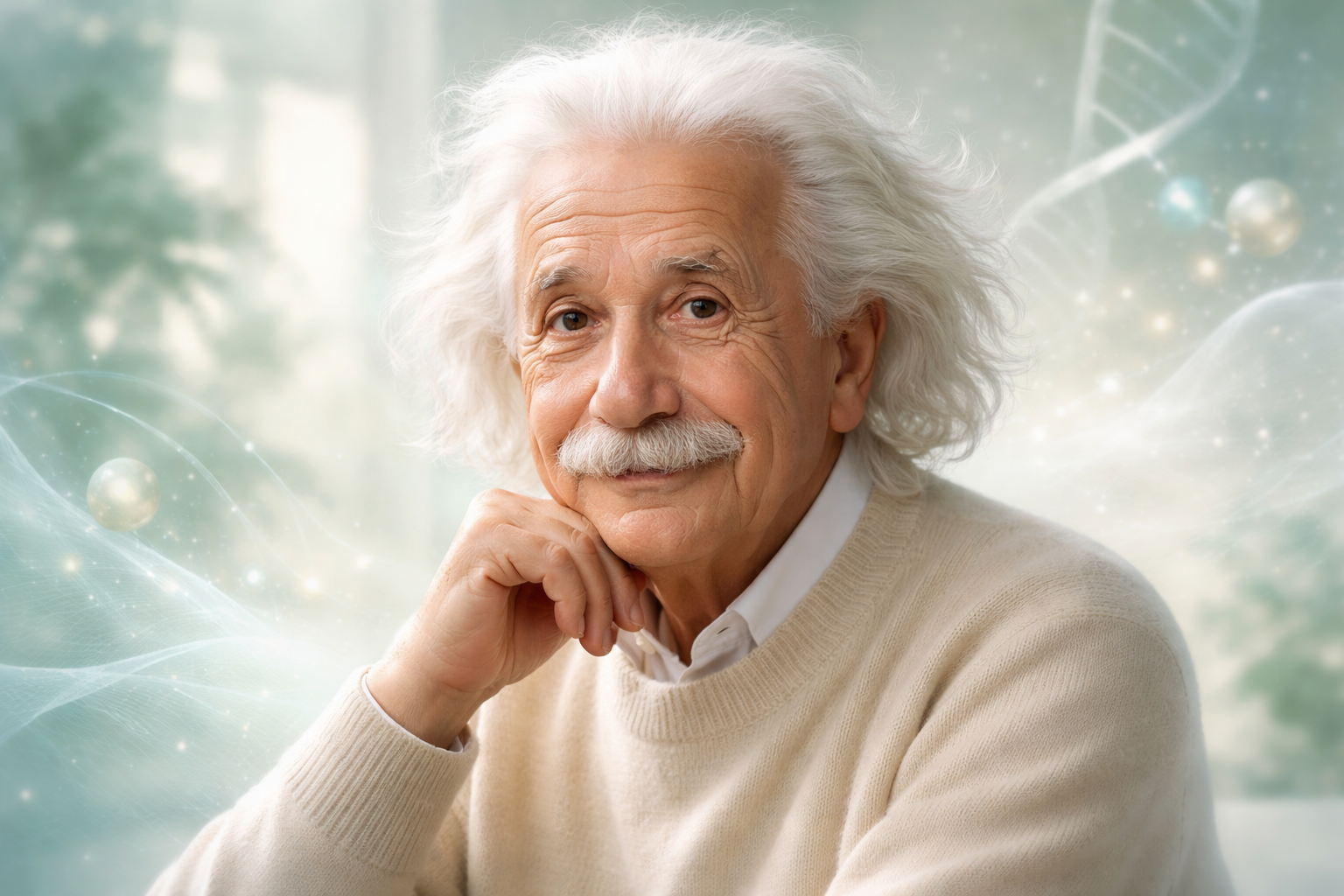
Albert Einstein was a German-born theoretical physicist, later naturalized Swiss and American, globally known for developing the theory of relativity. His work profoundly transformed the understanding of time, space, and energy. Although not a longevity specialist, his discoveries indirectly influence modern biomedical sciences, particularly through technologies derived from fundamental physics that now support research in health and life extension.
A singular figure of the twentieth century, Albert Einstein embodies a scientific approach driven by curiosity, intuition, and a constant questioning of established certainties. His intellectual posture extends far beyond physics. He advocates a vision of knowledge in which imagination precedes discovery, as he stated: “Imagination is more important than knowledge. For knowledge is limited, whereas imagination embraces the entire world.” This way of thinking opens an essential path for contemporary sciences, including those related to longevity, where conceptual breakthroughs are often required to overcome current biological limits.
The journey
Albert Einstein’s path did not follow a linear academic trajectory. Born in 1879 in Ulm, he showed an early interest in science but struggled within an educational system he found rigid. After studying at the Swiss Federal Polytechnic in Zurich, he had difficulty securing an academic position and instead worked at the patent office in Bern. It was in this environment, far from traditional academia, that he developed his major works in 1905, including special relativity and the equation E=mc². This year is often referred to as his annus mirabilis. His recognition accelerated with the development of general relativity in 1915, followed by the Nobel Prize in Physics in 1921 for his work on the photoelectric effect. His fame quickly extended beyond the scientific world, making him a public figure engaged in issues such as peace and scientific responsibility.
His vision of longevity
Einstein’s vision, when applied to longevity, does not rely on a direct biological approach but rather on a profound transformation of our relationship to time and matter. By redefining time as a relative rather than absolute dimension, he reshaped the very foundations upon which life sciences are built. This conception indirectly influences modern disciplines such as biophysics, medical imaging, and precision technologies used in medicine. Einstein also emphasized the necessity of transcending established frameworks to make progress. He stated: “We cannot solve our problems with the same thinking we used when we created them.” This idea strongly resonates within the field of longevity, where traditional approaches to health are reaching their limits in addressing aging. His thinking encourages an interdisciplinary approach, combining physics, biology, and technology to explore new solutions. In this perspective, longevity becomes less a question of biological duration and more a systemic challenge involving understanding, innovation, and the transformation of scientific paradigms.
Influence and impact
Albert Einstein’s influence on contemporary science is both considerable and structural. His work enabled the development of key technologies such as advanced medical imaging, satellite navigation systems, and certain measurement methods used in biomedical research. His intellectual legacy also fuels debates on the limits of science and the responsibility of researchers. In the field of longevity, he did not propose direct solutions but imposed a methodological standard: to think differently. This stance continues to inspire researchers exploring the frontiers of aging, regenerative medicine, and artificial intelligence applied to health.
Rethinking time and longevity
Albert Einstein never worked on longevity in the biological sense, yet his influence on how science is conceived remains decisive. By introducing a relative vision of time and valuing imagination as a driver of discovery, he opened an essential intellectual space for future innovations in health. In a context where longevity is becoming a major issue of the twenty-first century, his legacy invites us to move beyond linear approaches and rethink the very foundations of research. The question is no longer simply how to live longer, but how to understand differently what it means to live in time.