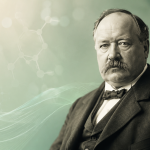
A major figure in twentieth century scientific history, Alan Turing is known as one of the founders of modern computing and artificial intelligence. His work on computing machines, cryptanalysis and mathematical logic profoundly transformed scientific research. Even though he never worked directly on longevity, his legacy now underpins many of the innovations that are transforming medicine and the understanding of aging.
When Alan Turing is mentioned, the dominant image is that of a rigorous mind, discreet yet radically focused on the future. Very early on, he defended a simple yet revolutionary idea for his time: machines can not only calculate, but also learn and evolve. This intuition does not stop at computing. It opens a new way of thinking about scientific knowledge, based on simulation, models and the power of computation. In a now famous conference, he declared: “We can only see a short distance ahead, but we can see plenty there that needs to be done.” This sentence summarizes his positioning: a researcher convinced that science is not only a discipline, but a projection toward what humanity can become.
The journey
Alan Turing’s path does not resemble a traditional academic trajectory. Very early attracted to mathematics and logic, he established himself in the 1930s with an idea that seemed abstract at the time but would transform the scientific world. By imagining a machine capable of performing any calculation from simple instructions, he laid the foundations of modern computing. This idea, which would later become known as the Turing machine, was not limited to theory. During the Second World War, he played a decisive role in decrypting German communications. This moment marked the transition from a discreet researcher to a central figure in scientific innovation. After the war, he continued his research on intelligent machines and on the possibility that a program could imitate human reasoning. This positioning, still very marginal at the time, would become one of the pillars of the technological revolution of the twenty first century.
His vision of longevity
Even though Alan Turing never used the word longevity in his work, his scientific vision is based on an idea that is deeply connected to it: the ability of technology to extend human possibilities. For him, the machine was not a passive tool, but an extension of intelligence. This vision now has a direct resonance in medical research. Large scale data analysis, biological simulations and predictive models that help us better understand aging all rely on principles he helped to formalize. In his article on intelligent machines, he wrote that the essential question was not whether a machine can think, but what it might allow human beings to understand. This approach remains at the heart of modern medicine. Today, research on aging no longer relies only on observation, but on the ability to analyze millions of biological data points and model complex processes. This shift in paradigm is directly linked to the computing revolution he initiated. Turing’s vision was not about replacing humans, but about giving them the means to go further. In this logic, longevity becomes less a biological question than a knowledge question. The more science understands how the human body works, the more it can act on aging. This idea, still theoretical in the 1950s, is now central to laboratories working on predictive medicine and prevention.
His influence and impact
Alan Turing’s influence cannot be measured only through his scientific discoveries, but through the way they transformed modern research as a whole. Computing has become a central tool in almost every discipline, including health and longevity. Researchers working on aging today use technologies that come directly from the logic he developed. His legacy can be seen in artificial intelligence, in genome modeling and in large scale medical data analysis. Yet his influence often remains indirect. He never tried to build an industry or promote an economic vision of technology. This positioning also explains why his impact is so durable: it is based on a deep transformation of the way science itself is conceived. Today, debates about artificial intelligence in medicine, the role of technology in health and the relationship between machines and humans directly extend the questions he was already raising in the 1950s.
A legacy that reshaped how science approaches the future of longevity
Alan Turing did not work on longevity in the biological sense of the term, but he profoundly transformed the tools that now make it possible to understand it. His legacy does not lie only in computing, but in a new way of thinking about science as a space for exploring the future. As medicine becomes more predictive and more technological, his influence becomes increasingly visible. The question may no longer be what he invented, but what his ideas still make possible.
Continue exploring longevity
Explore this longevity topic