Key elements
- Key benefits: postbiotic derived from the fermentation of Bifidobacterium, used in cosmetics to support the skin barrier
- Main mechanism: may contribute to reinforcing the natural mechanisms of skin repair when facing environmental stressors
- Role: in vitro and clinical research suggest involvement in improving skin resilience to UV
- Practical application: associated with a gentle modulation of inflammatory skin responses and oxidative stress
- Study insight: one research published in the Journal of Investigative Dermatology has observed improvements in markers of skin DNA repair
In the field of biotechnology applied to the skin, Bifida ferment lysate holds a particular place. It is derived from the fermentation of bacteria belonging to the genre Bifidobacterium. It is an ingredient part of the postbiotic family, meaning bioactive fragments obtained after microbial fermentation. It is now widely integrated into skincare aimed at supporting the natural functions of skin protection and repair.
Its scientific interest lies in its potential ability to interact with biological mechanism of the skin, particularly those involved in responses to environmental stress and in the balance of the skin microbiome. In a skin longevity approach, it is often studied for its ability to support the skin in adapting to daily stressors, such as UV exposure or pollution. This article explores the mechanisms of Bifida ferment lysate, its potential benefits, and its place in a modern skincare routine.
What is Bifida ferment lysate?
It is an ingredient derived from the fermentation of probiotic bacteria, followed by their lysis (fragmentation). Unlike living probiotics, it does not contain any active micro-organisms, but rather bioactive cellular components and metabolites.
Biologically, it is considered as a postbiotic. It is mainly used in cosmetics for its potential interactions with the skin barrier and epidermal cells.
Its particularity resides in its ability to remain stable, well tolerated and easily integrated into topical formulations, while keeping an interesting biological activity on skin functions.
“Extract from Bifidobacterium may contribute to improving repair of UV-induced damages at the level of skin DNA”
How does this work?
Main action
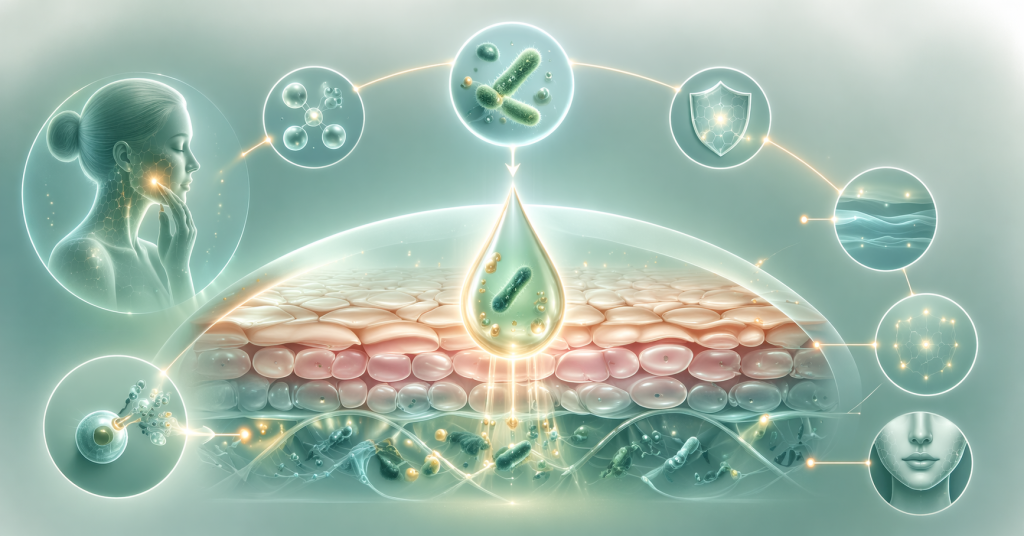
Bifida ferment lysate is studied for its ability to modulate cellular skin responses when facing environmental stress.
It may act by supporting natural mechanism of DNA repair, while also contributing to a better regulation of local inflammatory signals. Its action is indirect even though biological and occurs through interactions with skin cells and the skin barrier.
Effects on tissues
At the skin level, several mechanisms are being explored:
- Skin: it supports the barrier function and improves resistance to external stressor
- Mild inflammation: it modulates some inflammatory responses related to oxidative stress
- Oxidative stress: potential lowering of effects due to UV
- Skin microbiome: it may contribute to a more balanced microbial environment
What it means for longevity
From a skin longevity perspective, this ingredient is interesting for its ability to come along natural protection and repair functions.
It does not “correct” the skin, but rather it may support fundamental biological processes, particularly those related to cellular resilience, the balance of the skin barrier and the management of environmental stress.
Closer look over research
2013 – Clinical and mechanistic study
https://pubmed.ncbi.nlm.nih.gov/23887695
Key results: topical application containing derivatives of Bifidobacterium showed improved repair of damages induced by UV and reduction in some cellular stress markers.
Benefits
Support for skin repair
Biologically, the skin has natural systems to repair its DNA. Bifida ferment lysate is studied for its ability to support these mechanisms after an exposition to UV.
In practice, this suggests potential interest in after-sun skincare or in routines aimed at preserving skin integrity.
Reinforcement of the skin barrier
The skin barrier plays an essential part in the protection against external aggressions. Certain research suggests that this ingredient may help maintain its functions.
This may contribute to more comfortable, less reactive and better hydrated skin over time.
Support for skin microbiome balance
The skin microbiome is part of overall skin balance. As a postbiotic, Bifida ferment lysate may interact indirectly with this ecosystem by promoting a more stable environment.
This may be particularly relevant in contexts of skin stress or temporary imbalance.
Natural sources
- Fermentation of Bifidobacterium longum
- Postbiotic biotechnologies
- Laboratories of fermented cosmetic
- Bacterial cultures controlled in bioreactors
- Purified cellular extracts derived from bacterial lysis
Dosage, forms and bioavailability
In cosmetic, Bifida ferment lysate is usually included at low but active concentrations and often comprised between 1% and 5% depending on formulations.
It is mainly used in the form of:
- Serums
- Moisturising creams
- Repairing care
- Anti-stress skin formulations
Its bioavailability is topical. It acts locally on the skin without the need of systemic absorption. It is often associated with ingredients such as ceramides, hyaluronic acids or other ferments to reinforce synergistic effects.
Safety and precautions
Bifida ferment lysate is usually considered as well tolerated, including for sensitive skin.
Undesirable effects are rare but may include:
- Mild transient irritation in very reactive skin
- Individual incompatibility with certain complete formulations
It is recommended to realise a patch test when introducing to new skincare product, particularly for sensitive or atopic skin.
How to insert it into a longevity routine
When to use it
It should be applied in the morning or evening, on clean skin and as part of daily or repairing skincare routines.
What to combine it with
It works well with hydrating and repairing actives such as hyaluronic acid, niacinamide and ceramides.
Example of simple routine
Start with a gentle cleanser, followed by a ferment-based serum, then a barrier cream and finish with sun protection in the morning.
Who may benefit most
Persons with skin exposed to environmental stress, urban skin, sensitive skin or looking for comfort and resilience.
A discreet biotechnology supporting skin resilience?
Bifida ferment lysate is the marker of a modern approach in cosmetic. It does not directly correct the skin but rather it supports its natural abilities of adaptation. By acting as a postbiotic, it is part of a logic of balance and respect for the skin’s biological systems.
From a longevity perspective, it may help preserve a more stable, more resilient skin that is more adapted to daily aggressions. It is a discreet yet scientifically relevant technology which is part of a broader vision of sustainable skincare.
Sources
Del Rosso, J. Q. et al. (2013). Effects of topical probiotics on skin health. Journal of Investigative Dermatology. https://pubmed.ncbi.nlm.nih.gov/23887695/
Jung, Y. J. et al. (2015). Postbiotics and skin barrier function. Skin Pharmacology and Physiology.
Sharma, G. et al. (2020). Microbiome and skin health: a review. International Journal of Cosmetic Science. https://pubmed.ncbi.nlm.nih.gov/32043625/
Review: Fermented ingredients in dermatology and cosmetic science. Cosmetics Journal.
Continue exploring longevity
Explore this longevity topic