Definition
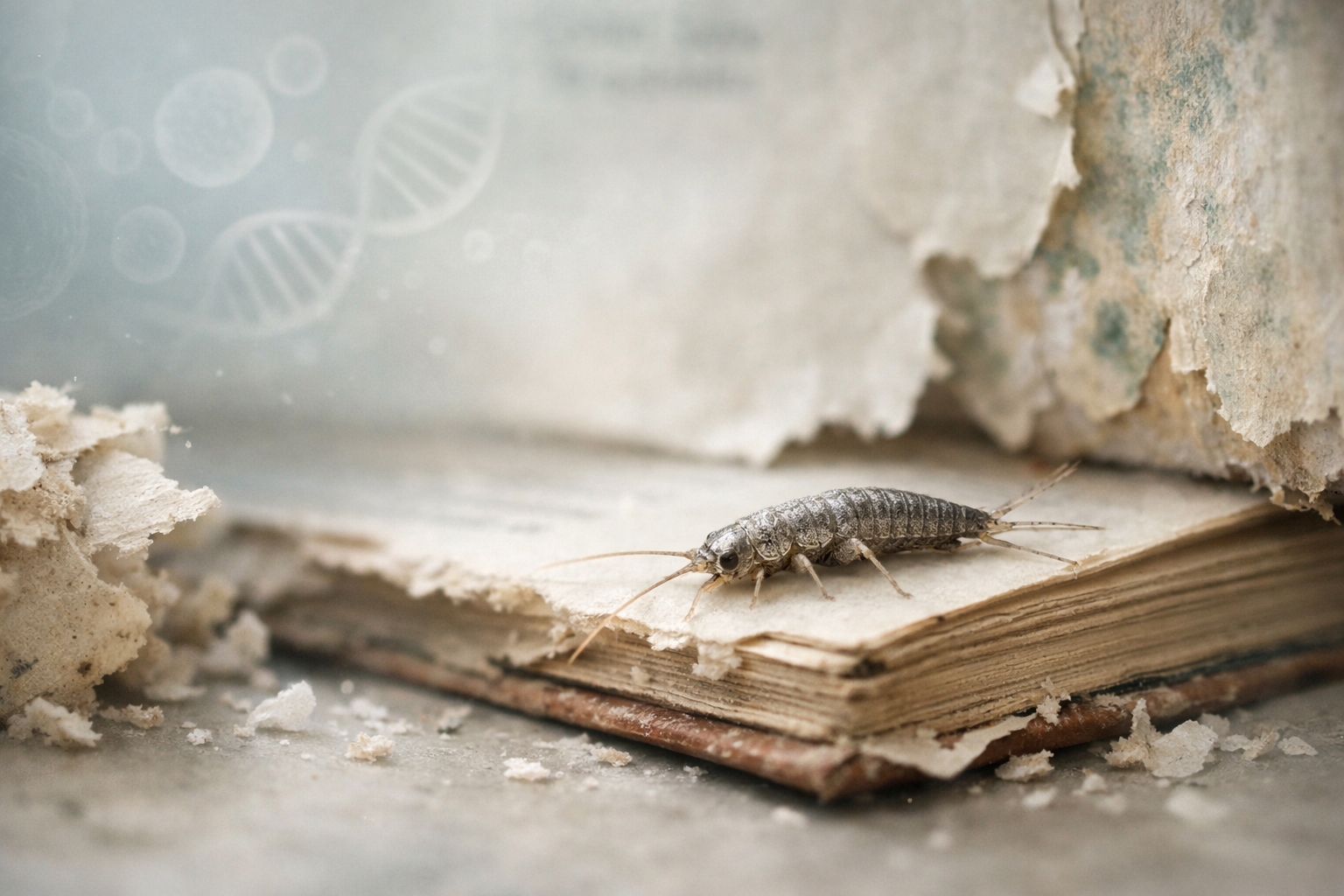
The silverfish (Lepisma saccharinum) is a small wingless insect from the Zygentoma family. It has an elongated body covered in silver-gray scales that measures between 7 and 12 millimeters. It is distinguished by rapid and undulating movements that resemble those of a fish, hence the common name.
It is characterized by rapid and undulating movements that resemble those of a fish, hence its common name.
This insect is photophobic, which means it avoids light and is most active at night, hiding in cracks, baseboards, behind furniture, or in damp areas of homes like bathrooms, kitchens, and basements. The silverfish primarily feeds on substances rich in starch or polysaccharides such as book glue, paper, certain textiles, food residues, or mold.
Unlike other domestic insects, it does not sting or bite humans. Its presence is mainly associated with minor material damage and favorable environmental conditions, particularly high humidity and moderate temperature.
Origin and context
The “silverfish” is an insect known for several centuries in human dwellings. The species Lepisma saccharinum is widely distributed in temperate and tropical regions. It has adapted to indoor life in buildings where temperature and humidity conditions are relatively stable.
Historically, its presence is mentioned in libraries, archives, and paper storage places. Ancient works containing starch-based glues represented an important food source for these insects.
Today, the silverfish is classified as a synanthropic insect, which means it lives in close contact with humans but does not rely on them for survival. Infestations are more common in homes with high humidity, insufficient ventilation, or water infiltration.
How does it function ?
The silverfish’s flattened body allows it to easily slip into narrow crevices, making it well-suited to humid and relatively stable environments. It has three long appendages at the end of its abdomen known as caudal filaments, which help it detect vibrations and threats. Its metabolism relies on the digestion of complex carbohydrates, particularly starch and modified cellulose. It can also consume proteins from organic debris, human scales, or mold. This great dietary diversity facilitates its establishment in many domestic environments.
The life cycle includes several larval stages that already resemble the adult. It does not have a chrysalis stage, unlike insects that undergo complete metamorphosis. Lifespan can reach three to eight years depending on environmental conditions. Females lay small eggs in protected crevices, which hatch after a few weeks when the temperature and humidity are optimal.
How is it studied ?
The silverfish has no direct relationship to medicine. Its presence is mainly studied in scientific fields.
In entomology, for example, it serves as a model for studying the evolution of primitive insects. Zygentoma are among the oldest groups of insects still present today. Their morphology provides information on the evolution of the body structures of arthropods.
In the field of archive conservation, this insect is monitored in libraries, museums, and archives where conservation professionals set up traps to protect documents and works containing paper or organic glues.
Its presence in homes also serves as an indirect indicator of excess humidity or poor ventilation.
Benefits and goals
The presence of silverfish in a habitat generally does not provide any direct benefit to the occupants. Its interest mainly lies in scientific observation and the understanding of domestic ecosystems.
In some cases, its study provides a better understanding of the interactions between insects and the indoor environment.
It can be:
✓ An indicator of high humidity levels in a building
✓ A study model for primitive insects in evolutionary biology
✓ A species useful for studying starch digestion mechanisms
✓ An ecological indicator of domestic micro-habitats
These observations help improve humidity management strategies and the preservation of sensitive materials in buildings.
Risks, limits and controversies
The silverfish is generally not considered dangerous to human health since it does not transmit diseases and does not have a stinging or biting mechanism.
The main issue with their presence is material damage, as these insects can deteriorate books, papers, certain natural textiles, and wallpapers with starch-rich adhesives. In rare cases, the significant presence of insects or their droppings can contribute to irritation in people sensitive to household allergens.
The infestation generally remains limited if humidity conditions are controlled. The most effective prevention methods are reduced humidity and improved ventilation.
Research and new developments
Current research on silverfish is primarily concerned with their physiology, adaptation to the domestic environment, and role in material degradation. Scientists are particularly interested in digestive enzymes capable of breaking down the complex polysaccharides found in paper and organic adhesives. These enzymes could inspire certain applications in biotechnology or organic waste management.
Non-toxic monitoring systems are being developed in the archive conservation field to detect the presence of these insects in libraries and museums early on. To avoid using insecticides that may harm the collections, pheromone traps and environmental control methods are preferred.
Short FAQ
Is the silverfish dangerous to humans?
No. This insect does not sting and does not transmit any known diseases. It can live in homes without direct interaction with the occupants. The inconveniences mainly concern material damage or the annoyance related to its presence.
Can the silverfish bite?
No. Its mouthparts are adapted for nibbling on organic materials rich in starch or complex sugars. It is not designed to bite human or animal skin.
Why do we find silverfish in the bathroom?
Bathrooms often offer a high humidity level and stable temperatures. These conditions are particularly favorable for the survival and reproduction of the insect.
Do silverfish indicate a hygiene issue?
Not necessarily. Their presence is more related to humidity than cleanliness. A clean but poorly ventilated home can also harbor them.
Can they damage books?
Yes. They consume the glue and the starch-rich components present in the paper. Holes or gnawed areas may appear on the pages or bindings.
How long does a silverfish live?
Its lifespan can reach several years. In favorable conditions, some individuals live between three and eight years and continue to molt even in adulthood.
Why do they appear at night?
They are light-fearing. Light constitutes a danger signal for them. They therefore mainly come out in the dark to feed.
How to limit their presence in a home?
Reducing humidity, improving ventilation, and sealing cracks significantly limits their development. Sticky traps also allow monitoring their presence.
Can silverfish infest clothing?
They can eat certain natural textiles containing starch or organic residues, but the damage is usually minimal.
Are they present all over the world?
Yes. The species is widely distributed in temperate and tropical regions. It easily adapts to the indoor environments of homes.
Key information
The silverfish is an ancient domestic insect, adapted to the humid and dark environments of homes, and it does not pose a direct danger to human health nor does it transmit diseases. The issues mainly involve minor damage to paper, books, or certain textiles. Its presence often indicates excess humidity or insufficient ventilation in the home. The primary prevention strategy is to control humidity, ventilate rooms, and reduce refuge areas in cracks and crevices.
Related Longevity Concepts
Scientific context
Field: Clinical medicine, biology, and preventive health
Biological process: Human physiology, pathology, and health-related mechanisms
Related systems: Metabolic, immune, cardiovascular, nervous, and cellular systems
Relevance to longevity: Understanding medical terminology and biological processes helps clarify how diseases, symptoms, biomarkers, and treatments influence long-term health, prevention, and healthy aging.