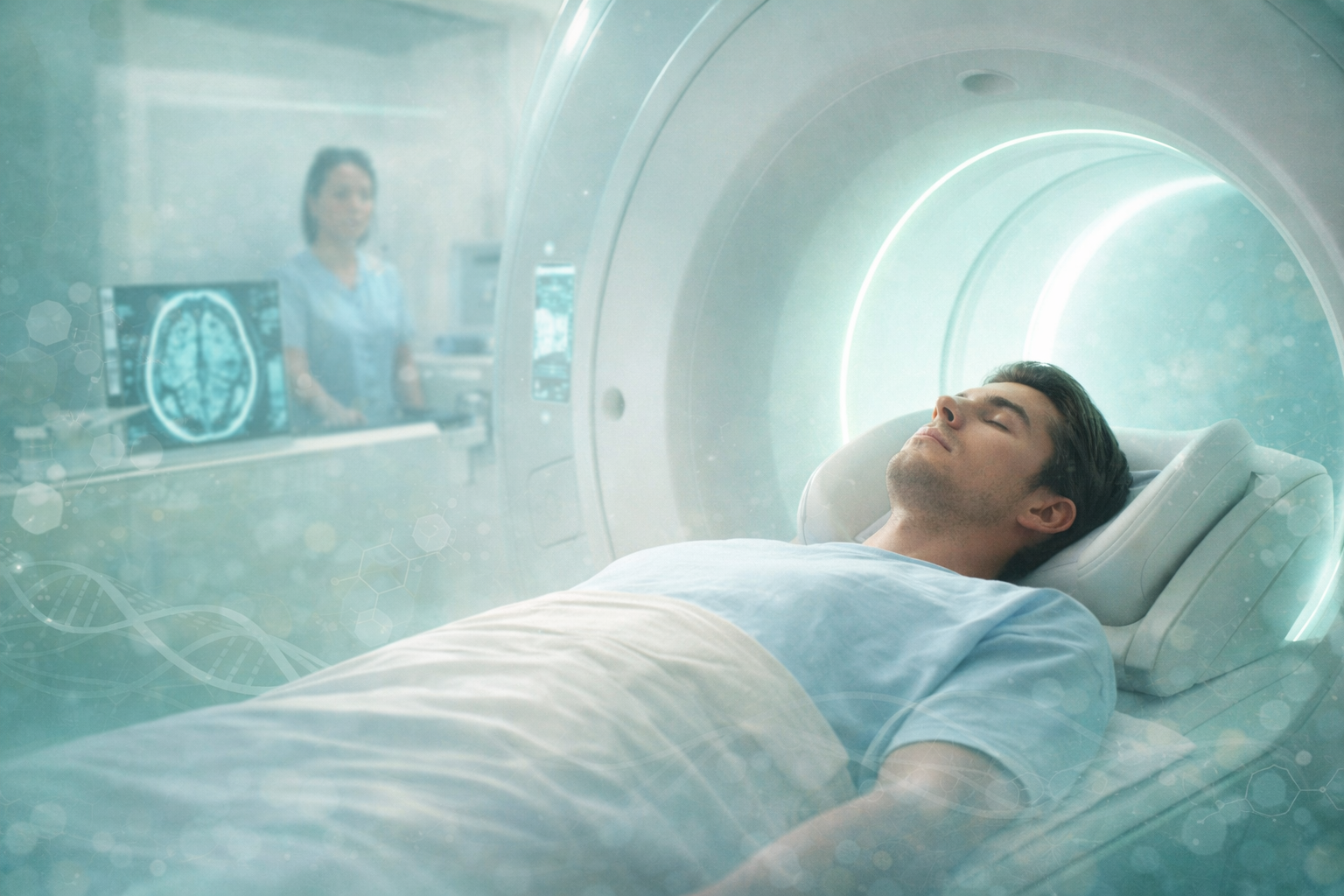
Definition
Magnetic resonance imaging (MRI) is a medical imaging technique that produces detailed images of internal body structures using strong magnetic fields and radiofrequency pulses. Unlike X-rays or CT scans, MRI does not rely on ionizing radiation, making it safer for repeated use.
MRI provides high-resolution images of soft tissues, including the brain, spinal cord, muscles, joints, and internal organs. The technique detects signals from hydrogen nuclei (protons) in water and fat molecules within the body. These signals are converted into cross-sectional images by a computer, revealing anatomical and, in some cases, functional information.
MRI is widely used in clinical practice to diagnose neurological, musculoskeletal, cardiovascular, and abdominal conditions. It can also assess tissue composition, blood flow, and abnormalities such as tumors, inflammation, or vascular malformations.
Origin and context of use
The concept of MRI emerged from advances in nuclear magnetic resonance (NMR) during the mid-20th century. Early experiments demonstrated that magnetic fields could detect hydrogen nuclei in biological tissues.
The first clinical MRI scans were performed in the 1970s and 1980s. These initial studies allowed visualization of brain anatomy and spinal cord lesions. The technique rapidly evolved with improvements in magnet strength, gradient coils, and computational processing.
MRI has become a cornerstone of modern diagnostic medicine. Its ability to provide non-invasive, high-resolution images without radiation has transformed neurology, orthopedics, cardiology, and oncology.
The technique is now widely available in hospitals, specialized imaging centers, and research facilities, supporting both clinical diagnosis and scientific investigation.
How does it work?
MRI operates on the principles of nuclear magnetic resonance. The body is placed within a strong magnetic field, aligning the magnetic moments of hydrogen protons in water and fat molecules.
Radiofrequency (RF) pulses are then applied, temporarily displacing these protons from alignment. When the RF pulse is turned off, protons return to their original orientation, releasing energy in the process. This energy is detected by receiver coils and measured as signals.
Gradients in the magnetic field allow the system to encode spatial information. Different tissues return to alignment at varying rates, generating contrast in the images. Parameters such as T1 and T2 relaxation times influence image brightness and can differentiate between tissue types.
Advanced MRI techniques include functional MRI (fMRI), which detects changes in blood oxygenation, and diffusion-weighted imaging (DWI), which tracks water molecule movement in tissues. Contrast agents, such as gadolinium, can further enhance visualization of blood vessels and lesions.
The entire process is controlled by sophisticated software that reconstructs the signals into detailed cross-sectional or 3D images for clinical interpretation.
In which cases is it used?
MRI is used to evaluate a wide range of medical conditions:
-
Neurology: brain tumors, stroke, multiple sclerosis, spinal cord injuries
-
Musculoskeletal system: ligament or tendon injuries, joint abnormalities, soft tissue tumors
-
Cardiology: structural heart defects, myocardial scarring, vascular anomalies
-
Abdominal and pelvic organs: liver, kidney, pancreas, reproductive organs
-
Oncology: tumor detection, staging, and monitoring response to therapy
MRI is preferred when detailed imaging of soft tissues is required, or when radiation exposure must be avoided, such as in pregnant patients or repeated follow-up studies.
Benefits and objectives
MRI offers multiple clinical and diagnostic advantages:
✓ Provides high-resolution images of soft tissues and organs
✓ Non-invasive and free of ionizing radiation
✓ Can differentiate between tissue types based on signal characteristics
✓ Supports functional and metabolic imaging (fMRI, DWI)
✓ Useful in planning surgeries and monitoring treatment outcomes
MRI allows early detection of diseases and assessment of internal structures without surgical intervention. Its versatility across organ systems makes it an essential tool in modern medicine.
Risks, limits or controversies
Although MRI is generally safe, there are some considerations and limitations:
-
Strong magnetic fields pose risks for patients with metallic implants, pacemakers, or certain prostheses
-
Claustrophobia may make the procedure uncomfortable for some patients
-
Gadolinium-based contrast agents can cause allergic reactions or complications in patients with severe kidney dysfunction
-
MRI is less effective for imaging structures containing bone, such as small fractures
-
The procedure is time-consuming and expensive compared to other imaging methods
MRI availability can be limited in some regions, and interpretation requires specialized radiologists.
Research and innovations
Current research focuses on improving MRI speed, resolution, and functional capabilities. Developments include:
-
High-field MRI scanners: stronger magnets provide more detailed images
-
Functional MRI (fMRI): mapping brain activity and neural networks
-
Diffusion and perfusion imaging: studying tissue microstructure and blood flow
-
Artificial intelligence: automating image reconstruction and diagnostic interpretation
-
Portable and open MRI systems: improving patient comfort and accessibility
Ongoing innovations aim to reduce scan times, enhance image clarity, and expand applications in precision medicine and neuroscience.
Short FAQ
What is magnetic resonance imaging (MRI)?
MRI is a medical imaging technique that uses magnetic fields and radio waves to produce detailed images of internal body structures without ionizing radiation.
Is MRI safe?
Yes, MRI is generally safe for most patients. Risks exist for people with metal implants or pacemakers, and contrast agents can pose complications in certain kidney conditions.
What can MRI detect?
MRI can visualize soft tissue structures, including the brain, spinal cord, muscles, joints, and internal organs. It is used for tumor detection, injuries, and vascular abnormalities.
How does MRI work?
The scanner uses a strong magnetic field to align hydrogen protons, applies radiofrequency pulses to excite them, and measures the energy released as protons return to alignment to generate images.
Does MRI use radiation?
No, MRI does not use ionizing radiation, making it safer for repeated imaging compared to X-rays or CT scans.
What is fMRI?
Functional MRI measures changes in blood oxygenation to map brain activity and study neural function.
Are contrast agents used in MRI?
Yes, substances like gadolinium enhance visualization of blood vessels, tumors, or lesions but may pose risks in patients with kidney issues.
How long does an MRI take?
Typical scans last between 15 and 60 minutes, depending on the region being imaged and the complexity of the study.
Can all patients undergo MRI?
Most patients can, except those with certain metallic implants, pacemakers, or devices incompatible with strong magnetic fields.
Why is MRI preferred over other imaging methods?
MRI provides superior soft tissue contrast, detailed anatomical and functional information, and avoids radiation exposure, making it ideal for many clinical applications.
Scientific context
Field: Clinical medicine, biology, and preventive health
Biological process: Human physiology, pathology, and health-related mechanisms
Related systems: Metabolic, immune, cardiovascular, nervous, and cellular systems
Relevance to longevity: Understanding medical terminology and biological processes helps clarify how diseases, symptoms, biomarkers, and treatments influence long-term health, prevention, and healthy aging.
Key Takeaways
Magnetic resonance imaging is a non-invasive diagnostic tool that produces detailed images of soft tissues using magnetic fields and radio waves. It is widely used in neurology, musculoskeletal medicine, cardiology, and oncology. MRI is safe for most patients but requires caution with metallic implants and contrast agents. Innovations in high-field scanners, functional imaging, and AI are expanding its clinical and research applications.
Related Longevity Concepts