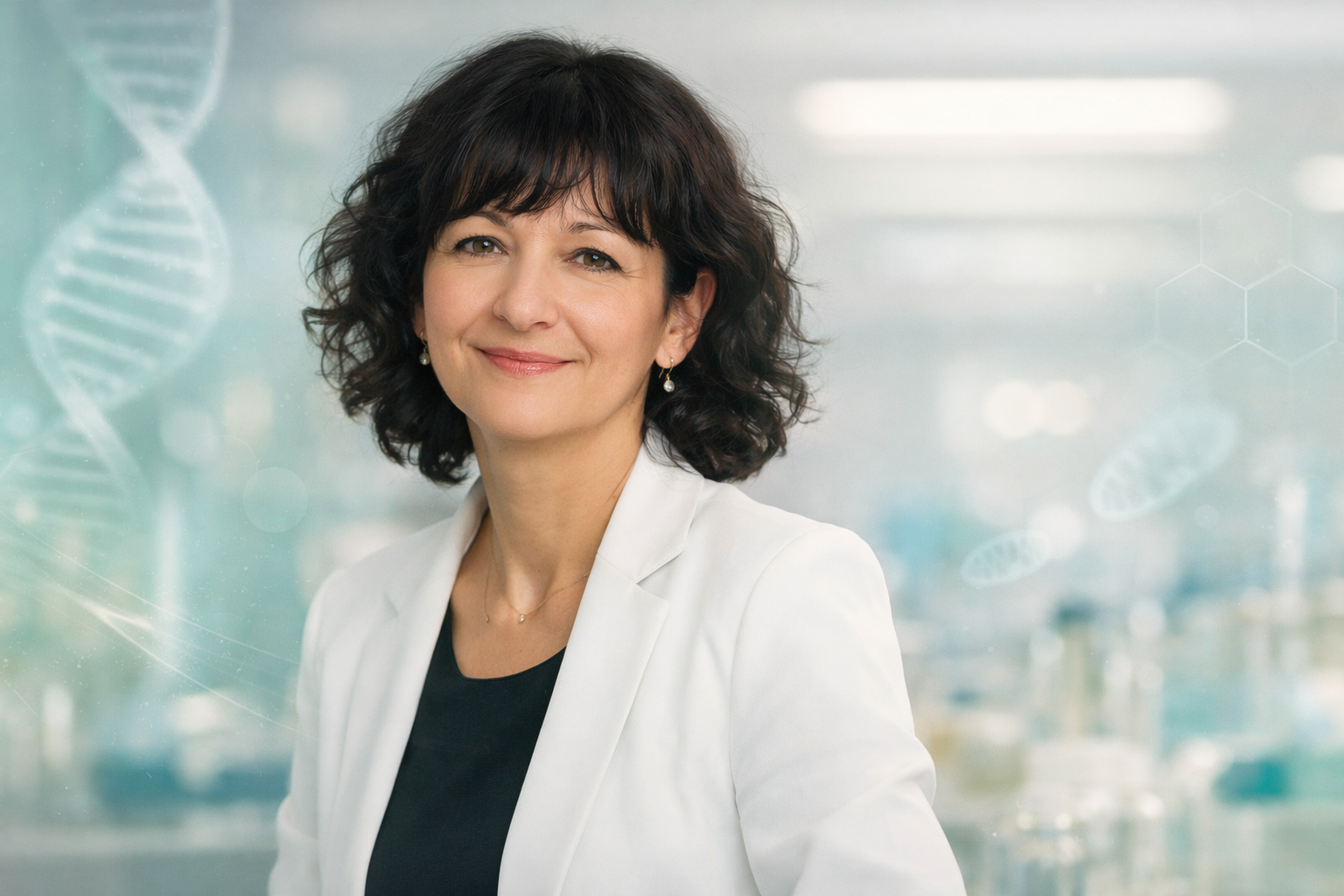
A leading figure in contemporary biology, Emmanuelle Charpentier is a French microbiologist and geneticist, co-recipient of the 2020 Nobel Prize in Chemistry for the development of CRISPR-Cas9 genome editing technology. Her work transformed gene editing into a programmable and accessible tool. This breakthrough now underpins a significant share of biomedical research, particularly in genetic diseases, cellular aging, and innovative therapeutic strategies connected to longevity.
Reserved yet resolute, Emmanuelle Charpentier represents a demanding, international, and deeply collaborative scientific culture. Her trajectory unfolded largely outside the most visible academic circuits before culminating in one of the major scientific breakthroughs of the twenty-first century. Her positioning has remained consistent: understand the fundamental mechanisms of life in order to act upon them with precision. In public interventions, she has emphasized that CRISPR is not a speculative promise but a scientific instrument. “CRISPR is a tool to understand the functioning of living organisms,” she has stated in conferences dedicated to biotechnology. This idea frames her approach to longevity: not as a pursuit of immortality, but as the rigorous mastery of biological mechanisms.
The path
Emmanuelle Charpentier began her scientific journey studying microbiology at the Institut Pasteur, later earning a PhD focused on bacterial molecular mechanisms. Early in her career, she chose an international path, holding research positions in the United States, Austria, Sweden, and Germany. This constant movement shaped her interdisciplinary perspective. In 2011, while leading a laboratory in Umeå, Sweden, she initiated a collaboration with Jennifer Doudna to investigate a poorly understood bacterial immune system. Together, they demonstrated that the CRISPR-Cas9 system could be reprogrammed to target and edit DNA with remarkable precision. Their 2012 publication marked a global scientific turning point. Laboratories and biotechnology companies rapidly adopted the technology. In 2020, the Royal Swedish Academy of Sciences awarded them the Nobel Prize in Chemistry, recognizing a discovery that fundamentally redefined genetic engineering.
Her vision of longevity
Emmanuelle Charpentier’s view of longevity is grounded in this same logic of fundamental understanding. For her, genome editing opens major perspectives in addressing age-related diseases, including neurodegenerative, cardiovascular, and metabolic disorders. Yet she consistently insists on strict ethical oversight. “We must use these technologies responsibly,” she has affirmed in interviews addressing the societal implications of genome editing. She draws a clear distinction between therapeutic research and germline modification. Her definition of longevity does not revolve around indefinite life extension but around improving the quality of years lived through precision medicine. She also emphasizes that CRISPR remains an evolving tool requiring continuous refinement to reduce off-target effects and ensure clinical safety. In public discussions, she highlights that scientific progress advances through rigorous validation rather than dramatic announcements. This position stands in contrast to the more speculative narratives sometimes associated with anti-aging biotechnology.
Influence and impact
Emmanuelle Charpentier’s influence extends well beyond academia. CRISPR technology has catalyzed the creation of numerous biotechnology companies and attracted substantial investment in gene therapy. It has also reignited debates about human genome editing, embryonic modification, and the ethical boundaries of regenerative medicine. Within the longevity field, CRISPR enables researchers to investigate genes involved in cellular senescence, DNA repair, and resilience to age-related diseases. Her impact is structural: she has reshaped the tools available to understand biological aging. Her measured and principled stance contributes to maintaining a balance between innovation and scientific responsibility.
Precision as the future of longevity
Emmanuelle Charpentier embodies a methodological revolution more than a spectacular promise. By making genome editing programmable and accessible, she has altered the trajectory of contemporary biomedical research. In the field of longevity, her contribution lies not in a miracle solution, but in the possibility of intervening precisely in the mechanisms of aging and associated diseases. As clinical applications of CRISPR continue to expand, the central question will not only be what science can achieve, but how society chooses to frame and govern its use.
Continue exploring longevity
Explore this longevity topic