Introduction
Pink Tibetan salt has become a familiar presence in modern kitchens, wellness retreats, and conscious nutrition conversations. Its soft rose color and origin story evoke purity, minerals, and a more natural relationship with food. For many, it feels like a healthier alternative to refined table salt.
Yet beyond the aesthetic and symbolic appeal, important questions remain. What exactly is pink Tibetan salt? Does it truly offer unique health benefits? And how does it fit into a longevity-oriented approach to nutrition?
At Sogevity, we believe that nutritional choices should be guided by clarity rather than mythology. Salt is essential to life. It regulates fluid balance, nerve signaling, and muscle contraction. But its health impact depends less on color or origin than on context, quantity, and overall dietary patterns.
This article explores pink Tibetan salt through a calm scientific lens. We will distinguish facts from assumptions and explain how to use salt in a way that supports long-term vitality.
Longevity begins with informed simplicity.
What is pink tibetan salt?
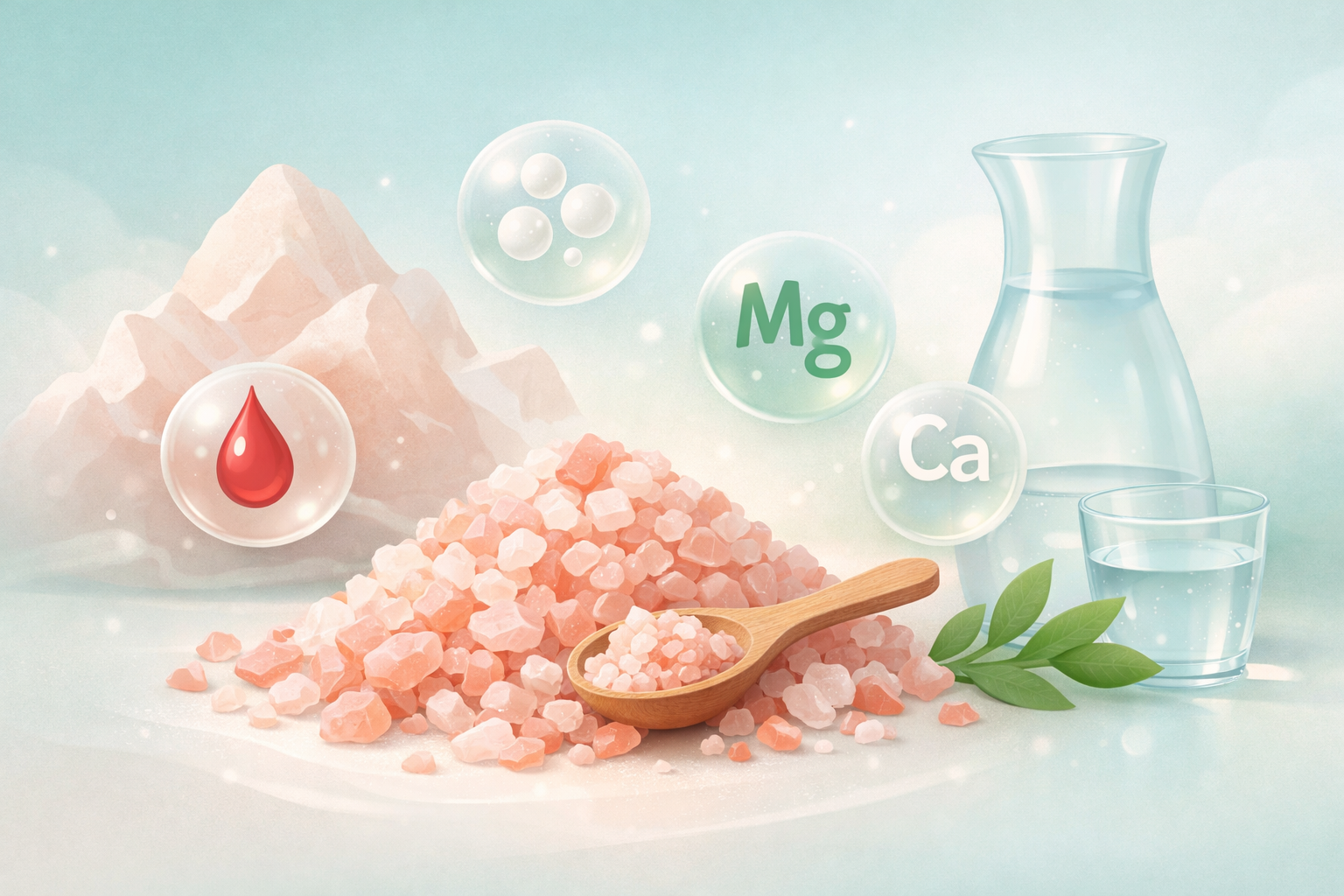
Pink Tibetan salt is a type of rock salt harvested from ancient salt deposits in regions associated with the Himalayan plateau. Its pink hue comes from trace amounts of minerals such as iron oxide, along with small quantities of magnesium, potassium, and calcium.
Chemically, however, pink Tibetan salt remains predominantly sodium chloride. Over 95 percent of its composition is sodium and chloride ions, similar to most culinary salts. The remaining trace minerals are present in very small concentrations.
Unlike refined table salt, pink Tibetan salt is typically less processed and does not contain added anti-caking agents. This contributes to its reputation as a more “natural” option, although natural does not automatically mean superior from a physiological standpoint.
Understanding its composition allows us to evaluate its role realistically, without dismissing its culinary or cultural value.
Mineral content: how meaningful is it?
One of the most common claims surrounding pink Tibetan salt is its mineral richness. While it does contain trace minerals, the quantities are nutritionally modest. To meet daily requirements for minerals such as magnesium or potassium through salt alone would require unsafe sodium intake.
From a longevity perspective, minerals are indeed essential. They support mitochondrial function, nerve transmission, and hormonal balance. However, meaningful mineral intake should come primarily from whole foods such as vegetables, fruits, nuts, seeds, and quality water.
Pink Tibetan salt can contribute marginally to mineral diversity, but it should not be viewed as a supplement. Its value lies more in what it does not contain, such as additives, rather than in what it adds in significant amounts.
Clarity protects both health and expectations.
Sodium, hydration, and metabolic balance
Sodium plays a critical role in maintaining blood volume, cellular hydration, and neuromuscular function. Completely minimizing salt intake can be as problematic as consuming too much, particularly for physically active individuals.
Pink Tibetan salt provides sodium in the same physiological form as other salts. Its impact on blood pressure or fluid balance depends on total intake, potassium balance, kidney function, and overall metabolic health.
In a diet rich in potassium-containing foods and low in ultra-processed products, moderate salt use is generally well tolerated. Problems often arise not from salt itself, but from excessive sodium hidden in industrial foods.
Used consciously, pink Tibetan salt can be part of a balanced hydration and electrolyte strategy, especially when paired with whole, unprocessed meals.
Culinary experience and mindful eating
Beyond chemistry, pink Tibetan salt offers a sensory experience. Its texture, subtle flavor variation, and visual softness encourage slower, more intentional seasoning. This can indirectly support mindful eating practices.
Mindful eating has been associated with improved digestion, better portion regulation, and reduced metabolic stress. When seasoning becomes intentional rather than automatic, it often leads to reduced overall salt use.
From a Sogevity perspective, this is where pink Tibetan salt finds its most meaningful role. Not as a health hack, but as a tool for awareness.
How we eat matters as much as what we eat.
Common myths and misconceptions
Pink Tibetan salt is sometimes marketed with claims of detoxification, energy balancing, or unique alkalizing properties. These claims are not supported by robust scientific evidence.
The body’s detoxification systems are managed primarily by the liver, kidneys, and digestive tract. Salt, regardless of its color, does not perform detoxification in a direct sense.
Similarly, the idea that pink salt dramatically alters body pH is misleading. Human blood pH is tightly regulated and not significantly influenced by dietary salt choices.
Dispelling these myths does not diminish the salt’s culinary value. It simply restores perspective.
Conclusion: a place for simplicity and moderation
Pink Tibetan salt is neither a miracle nor a threat. It is a minimally processed salt with aesthetic and culinary appeal, offering sodium in a familiar biological form and trace minerals in modest amounts.
When used in moderation, within a diet rich in whole foods and supported by adequate hydration, it fits comfortably into a longevity-oriented lifestyle. Its greatest contribution may be its ability to reconnect us with intentional seasoning and conscious consumption.
At Sogevity, longevity is built on understanding, not exaggeration. Pink Tibetan salt reminds us that sometimes, the most sustainable choices are also the simplest.Sogevity. The longevity experience
Live longer. Live better.
Continue exploring longevity
Explore this longevity topic